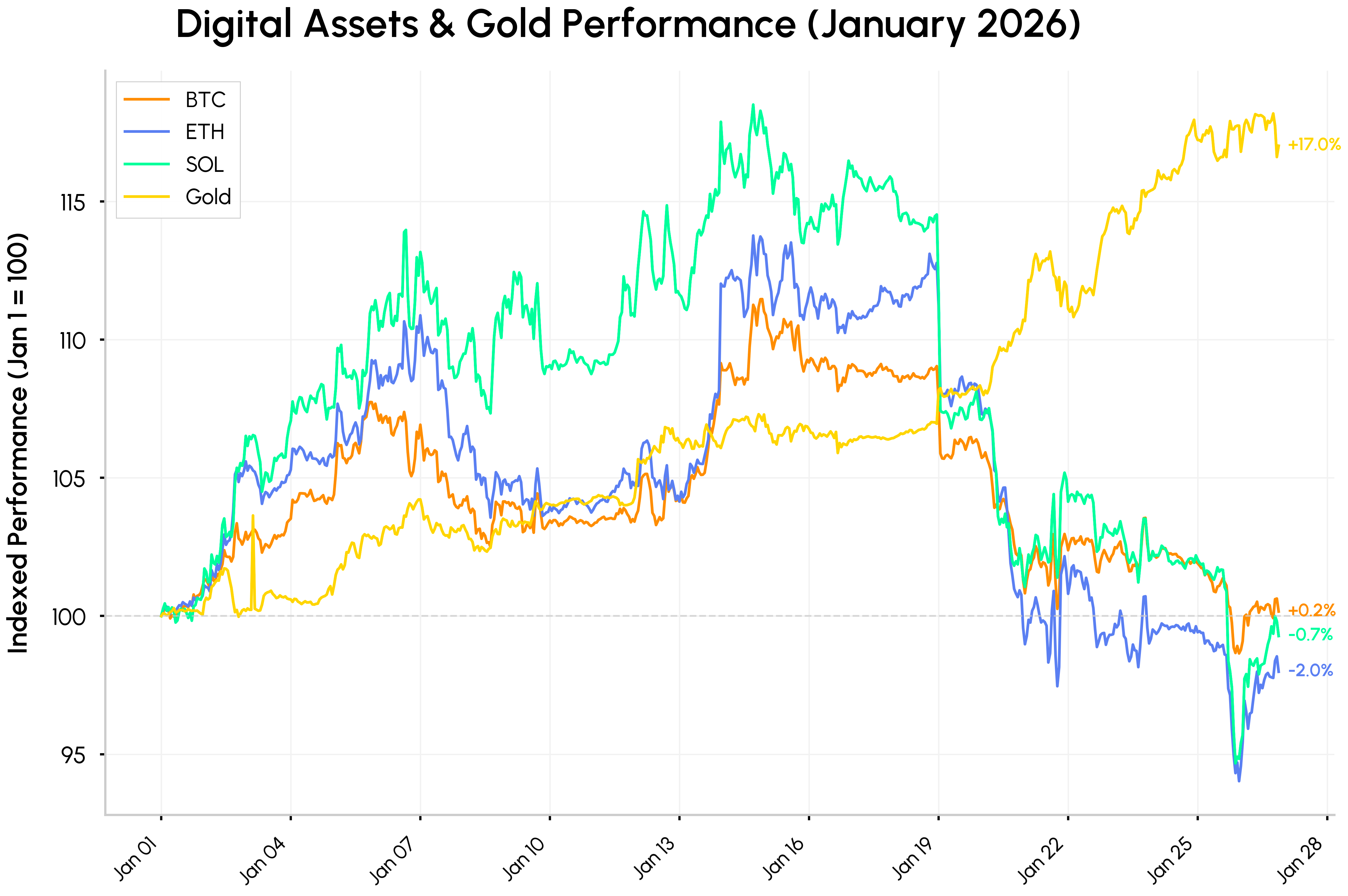
Gold Soars to Record $5,000 as Institutional Capital Shifts Amid Market Volatility
The global financial landscape witnessed a historic shift in January 2026 as gold prices shattered previous records, climbing past the $5,000 per ounce mark. This unprecedented rally is largely attributed to a flight to safety among investors, who are increasingly wary of escalating geopolitical tensions, protectionist trade policies, and the long-term implications of current central bank strategies. As capital flows into traditional safe-haven assets, the precious metal has solidified its role as the primary hedge against systemic uncertainty.
In contrast, the digital asset sector has faced a period of consolidation. While Bitcoin attempted to sustain momentum near the $97,000 level, it has struggled to maintain consistent growth. Institutional behavior remains bifurcated; companies like MicroStrategy continue to aggressively bolster their Bitcoin reserves, recently adding 37,000 BTC to reach a total of 700,000 BTC. Conversely, Bitcoin exchange-traded funds (ETFs) have seen notable outflows, signaling that broader institutional players are currently prioritizing liquidity and risk management over speculative digital exposure.
Despite the price stagnation in the crypto market, the underlying infrastructure is showing signs of significant maturation. Ethereum has reached a milestone with over 30% of its total supply now staked, while the New York Stock Exchange is advancing plans for a platform dedicated to tokenized securities. Furthermore, the successful public debut of BitGo on the NYSE, which achieved a $2.6 billion valuation, underscores a growing investor appetite for regulated crypto infrastructure. These developments suggest that while legislative progress, such as the CLARITY Act, remains stalled in Washington, the institutional framework for digital assets continues to evolve steadily.
Key Takeaways
- Gold prices hit an all-time high of $5,000 per ounce, driven by global geopolitical instability and fiscal concerns.
- MicroStrategy continues its long-term Bitcoin accumulation strategy, even as Bitcoin ETFs experience institutional outflows.
- The digital asset industry is shifting focus toward regulated infrastructure, highlighted by the NYSE's tokenization plans and BitGo's successful IPO.
Editor’s Analysis & Impact
The divergence between gold and Bitcoin in early 2026 underscores a pivotal moment in market sentiment. Gold is currently serving as the definitive hedge against systemic risk, a role that Bitcoin has yet to fully secure in the eyes of conservative institutional investors. The ‘digital gold’ narrative is being rigorously tested as crypto assets demonstrate a lack of correlation with physical precious metals during times of crisis. However, the industry is clearly pivoting toward institutional-grade infrastructure. The focus on tokenized securities and regulated public offerings suggests that the next phase of growth will be driven by integration with traditional financial systems rather than purely speculative retail demand. Future market stability will likely hinge on the resolution of regulatory frameworks, which remain the primary bottleneck for broader, mainstream adoption.
Frequently Asked Questions
Q: What factors contributed to gold reaching the $5,000 milestone?
A: The surge was driven by a combination of heightened geopolitical tensions, international trade disputes, and widespread concerns regarding central bank policies and rising national debt levels.
Q: How does the current institutional approach to Bitcoin differ between corporations and ETFs?
A: MicroStrategy maintains a long-term, price-agnostic accumulation strategy, whereas Bitcoin ETFs have seen net outflows, indicating that broader institutional investors are currently adopting a more risk-averse, momentum-driven approach.
AI Disclosure: This article is based on verified data and official reports. Our Team and AI have cross-referenced every financial detail with primary sources to ensure total accuracy.
More from this Category