Genesis AI Unveils Full-Stack Strategy with Human-Like Robotic Hands and New AI Model
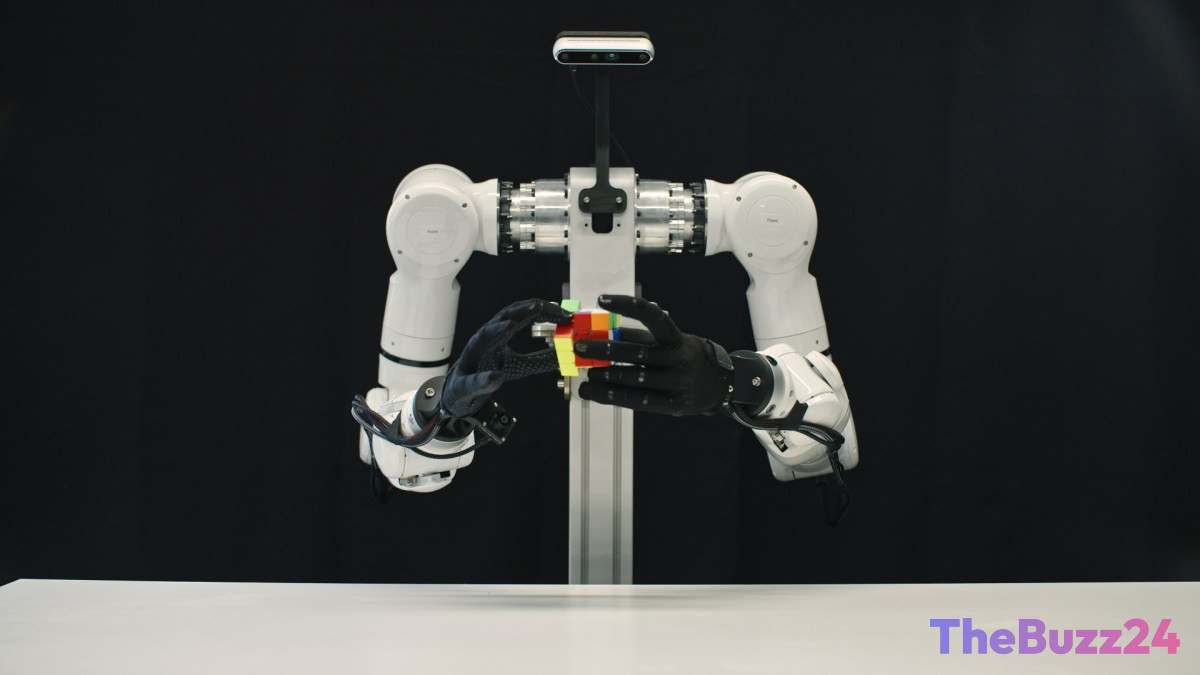
Robotics startup Genesis AI has transitioned to a full-stack development model, showcasing its new GENE-26.5 artificial intelligence model alongside custom-designed, human-sized robotic hands. Initially focused on building foundational AI models for robotics, the company pivoted to hardware development to gain precise control over physical execution. By designing five-fingered hands that mimic human anatomy rather than relying on standard two-finger grippers, Genesis AI aims to bridge the “embodiment gap” and gather highly accurate real-world data.
In demonstrations, the robotic hands successfully completed complex, multi-step tasks such as cracking eggs, slicing tomatoes, preparing smoothies, and solving Rubik’s cubes. To accelerate training, Genesis AI developed a lightweight, sensor-equipped glove that allows human workers to seamlessly record data during their daily routines. This wearable tech, combined with egocentric video footage and advanced simulation software, allows the startup to rapidly iterate its AI models. While the data collection method raises questions regarding workplace dynamics and employee compensation, the company is actively exploring partnerships to build a comprehensive “human skill library.”
Backed by a $105 million seed round co-led by Eclipse and Khosla Ventures—with participation from high-profile investors like former Google CEO Eric Schmidt—Genesis AI has rapidly scaled its operations. The company now employs 60 people across offices in Paris, California, and London, leveraging Europe’s dense talent pool. Looking ahead, the startup plans to expand beyond isolated robotic hands to debut a fully integrated, general-purpose humanoid robot, solidifying its ambition to build the world’s most capable robotic system.
Key Takeaways
- Genesis AI has shifted to a full-stack approach, developing both the GENE-26.5 AI model and human-sized robotic hands to improve data collection and task execution.
- The startup utilizes a lightweight, sensor-loaded glove and simulation tools to gather real-world human movement data, though labor and compensation questions remain.
- Supported by $105 million in seed funding and prominent investors, Genesis AI is expanding its international team and plans to launch a full-body general-purpose robot.
Editor’s Analysis & Impact
The transition of Genesis AI to a full-stack model highlights a growing trend in the robotics industry: the realization that software alone cannot solve physical manipulation challenges. By designing human-like hands, Genesis AI directly addresses the “embodiment gap,” allowing its AI to learn from natural human movements rather than translating actions to simplified grippers. This approach could significantly accelerate commercial viability in complex environments like laboratories and manufacturing plants. However, the reliance on worker-worn data-collection gloves introduces a delicate labor dynamic. If companies expect workers to train their robotic replacements, issues of fair compensation and intellectual property rights over physical skills will inevitably surface. Ultimately, Genesis AI’s rapid scaling and high-profile backing position it as a formidable competitor to established players, signaling that the race for general-purpose humanoid robotics is intensifying.
Frequently Asked Questions
AI Disclosure: This article is based on verified data and official reports. Our Team and AI have cross-referenced every financial detail with primary sources to ensure total accuracy.
More from this Category