Psyche Spacecraft Snaps Striking Crescent Mars Image During Deep Space Navigation
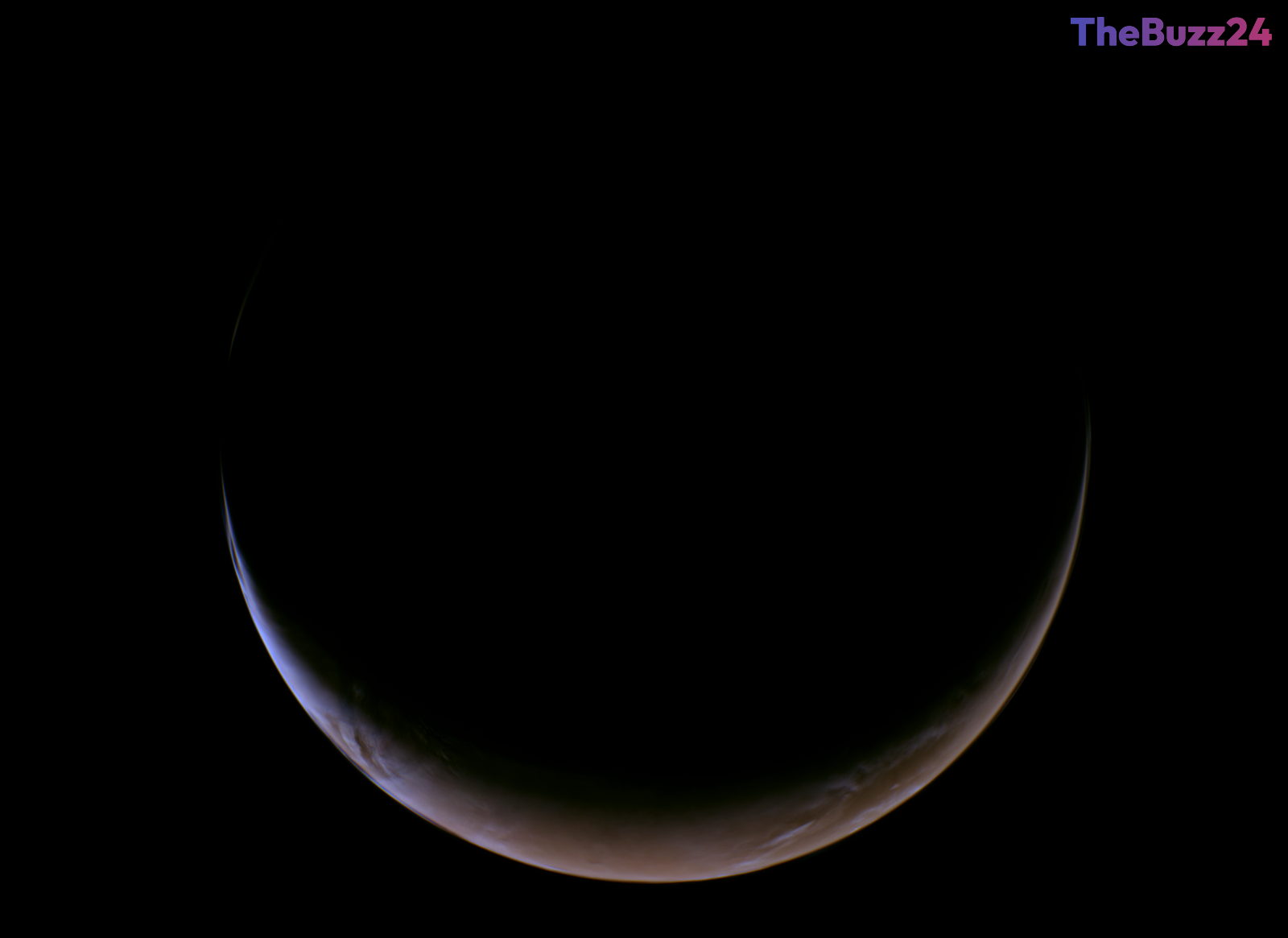
The Psyche spacecraft has captured a remarkable image of Mars, showcasing a vivid crescent phase during a crucial gravity assist maneuver. The photograph, taken on May 15, 2026, marks the last opportunity for the probe to image the Red Planet in its entirety before it ventures too far for its cameras to capture effectively.
This maneuver was instrumental in fine-tuning the spacecraft’s path as it continues its extensive journey toward a distant, metal-rich asteroid. Utilizing its advanced multispectral imager, Psyche documented Mars from a high phase angle, revealing a slender, sunlit arc of the planet. Mission scientists were particularly intrigued by the observation that the Martian crescent appeared considerably brighter and more expansive than anticipated based on pre-flight projections.
Preliminary analysis suggests that this enhanced luminosity is a consequence of intense solar radiation scattering off the planet’s atmosphere, which is laden with dust particles. The image was meticulously processed by technicians who combined data from the imager’s red, green, and blue filters to create a natural-color representation. This achievement not only confirms the robust functionality of Psyche’s scientific instruments but also furnishes valuable real-world data on atmospheric light scattering phenomena.
Key Takeaways
- The Psyche spacecraft captured a rare crescent view of Mars during a gravity assist maneuver on May 15, 2026.
- The observed crescent was brighter than expected, likely due to light scattering within the Martian atmosphere.
- The mission successfully utilized multispectral imaging to generate a natural-color representation of the planet.
Editor’s Analysis & Impact
The Psyche spacecraft’s successful imaging of Mars during a navigational maneuver highlights the increasing synergy between mission objectives and opportunistic scientific discovery. Gravity assists, traditionally viewed as purely functional for trajectory correction, are proving to be valuable moments for data acquisition. The unexpected brightness of the Martian crescent offers crucial insights into atmospheric dynamics and light scattering, refining scientific models. This event underscores the potential for long-duration space missions to yield significant scientific returns even during transit phases, maximizing the value of complex exploratory endeavors and paving the way for more efficient future deep-space investigations.
Frequently Asked Questions
Q: Why did the Psyche spacecraft capture an image of Mars?
A: The image was captured during a gravity assist maneuver, a technique used to adjust the spacecraft's trajectory and velocity by utilizing the gravitational pull of a planet.
Q: What is the primary objective of the Psyche mission?
A: The mission is designed to travel to and study a unique, metal-rich asteroid located in the main asteroid belt to gain insights into the formation of planetary cores.
Q: What is a gravity assist maneuver?
A: A gravity assist, also known as a gravitational slingshot, is a maneuver that uses the gravity of a planet or other celestial body to alter the path and speed of a spacecraft, reducing the need for onboard fuel.
AI Disclosure: This article is based on verified data and official reports. Our Team and AI have cross-referenced every financial detail with primary sources to ensure total accuracy.
More from this Category