Perseverance Rover Captures Ancient Martian Landscape: A Glimpse into Jezero Crater’s Deep Past
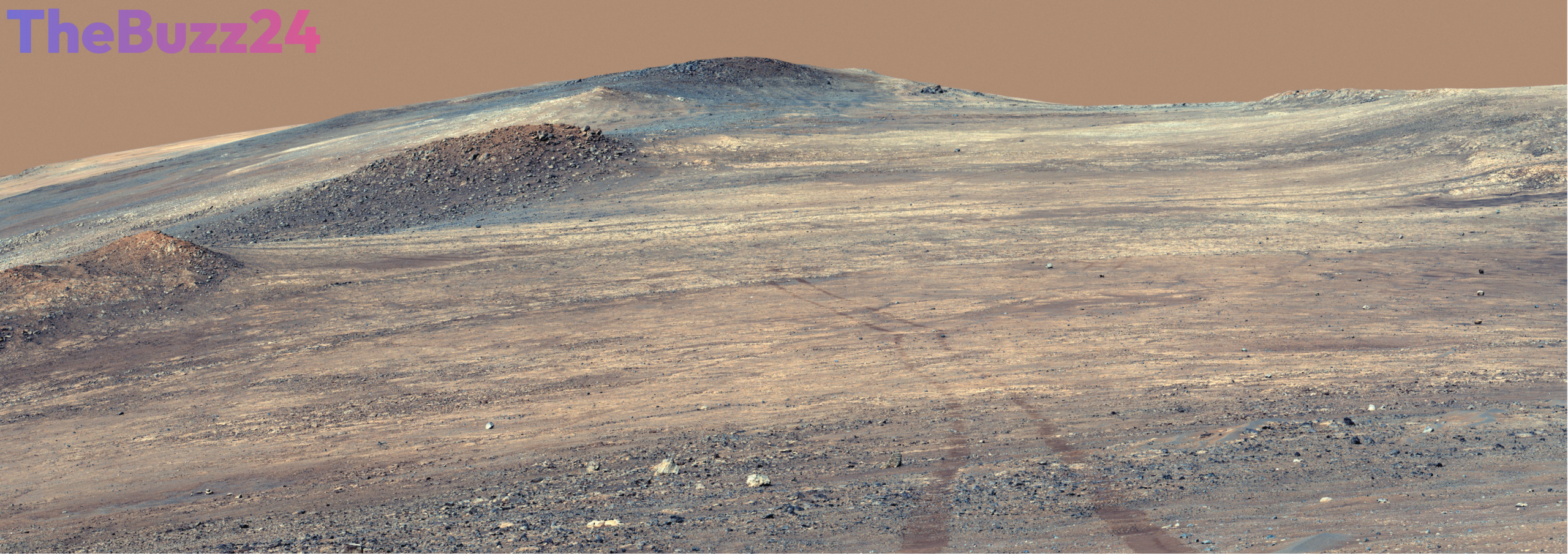
NASA’s Perseverance rover has transmitted a striking panoramic view from the edge of Jezero Crater on Mars, offering an unprecedented look at a geological formation estimated to be over 3.9 billion years old. The image, captured on May 15, 2025, showcases the outer lip of the crater’s 490-foot-tall rim, revealing a significant geological feature known as the “Broom Point member.”
This ancient rock formation, spanning approximately 245 feet in thickness, presents a stack of layered bedrock that scientists believe is among the oldest terrain ever investigated by a Mars rover. Evidence gathered by Perseverance suggests that this thick sequence of rock was shaped by a history of asteroid impacts. Subsequent colossal impacts that formed the Isidis Basin and Jezero Crater itself appear to have tilted these layers to nearly vertical angles, exceeding 80 degrees.
The captured image also clearly displays the rover’s own tracks, marking its descent down the steep slope of the crater rim. Annotations on a detailed version of the image highlight the boundaries of the Broom Point member, the rover’s path, and specific locations where scientific data was collected and rock core samples were obtained, including samples named “Bell Island” and “Main River.”
Key Takeaways
- Perseverance rover has captured a detailed view of the ancient "Broom Point member" formation on the rim of Jezero Crater.
- The rock layers in Broom Point are over 3.9 billion years old, offering insights into Mars' early history.
- The formation's structure suggests it was shaped by asteroid impacts and subsequent crater formation events.
Editor’s Analysis & Impact
This latest imagery from the Perseverance rover provides invaluable data for understanding the early geological history of Mars, particularly the conditions within Jezero Crater billions of years ago. The extreme tilting of the Broom Point member layers offers compelling evidence of the powerful impact events that shaped the Martian surface. Such findings are crucial for refining models of planetary formation and evolution, and they continue to fuel the search for signs of ancient microbial life by providing context for the geological environments that may have once supported it. The detailed sampling locations also indicate a systematic approach to unraveling Mars’ complex past.
Frequently Asked Questions
Q: What is the "Broom Point member"?
A: The "Broom Point member" is a geological formation on the rim of Jezero Crater on Mars, characterized by a 245-foot-thick stack of ancient, layered bedrock estimated to be over 3.9 billion years old. Its layers are tilted at steep angles due to past impact events.
Q: What is the significance of the Broom Point member's age and structure?
A: Its immense age makes it one of the oldest geological features examined by a Mars rover, offering a direct window into the planet's early history. The nearly vertical tilt of the rock layers provides evidence of the powerful asteroid and impact events that significantly altered Mars' surface billions of years ago.
Q: What scientific instruments were used to capture this view?
A: The sweeping view was captured by the Mastcam-Z instrument aboard NASA's Perseverance rover.
AI Disclosure: This article is based on verified data and official reports. Our Team and AI have cross-referenced every financial detail with primary sources to ensure total accuracy.
More from this Category