No Tanks in Red Square: Putin Denounces NATO During Highly Guarded Victory Day Parade
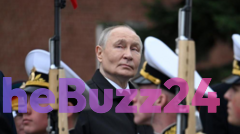
Russian President Vladimir Putin delivered his annual Victory Day address in Moscow’s Red Square, using the historic platform to defend the ongoing military campaign in Ukraine and launch a sharp critique against NATO. Speaking to hundreds of military personnel, Putin framed the conflict—now in its fifth year—as a “just” struggle against an aggressive force backed and armed by the Western alliance.
This year’s celebrations, which commemorate the Soviet Union’s victory over Nazi Germany in World War II, were notably scaled back due to heightened security concerns and fears of potential Ukrainian drone strikes. For the first time in years, the traditional display of heavy military hardware, including armored vehicles and ballistic missiles, was entirely absent from the Red Square parade. Officials explained that military assets were prioritized for active deployment on the front lines rather than ceremonial displays.
The event took place amid a fragile three-day ceasefire, which had been initiated late last week. However, shortly after the parade concluded, Russia’s defense ministry accused Ukrainian forces of violating the truce, though specific details were not immediately provided. International attendance at the event was also visibly diminished compared to previous milestone anniversaries. Notable foreign dignitaries who did attend included Belarusian President Alexander Lukashenko, Slovak Prime Minister Robert Fico—the sole European Union representative present—and leaders from Malaysia and Uzbekistan.
Despite the reduced scale, Putin emphasized the historical continuity between the sacrifices of the 27 million Soviet citizens who died in World War II and the soldiers currently fighting in Ukraine. He praised the resilience of the Russian public, highlighting the contributions of scientists, doctors, and industrial workers to the national effort, asserting that the country’s future ultimately rests on the strength of its people.
Key Takeaways
- Russian President Vladimir Putin used his Victory Day speech to frame the Ukraine conflict as a defensive war against a NATO-backed adversary.
- For the first time in years, Moscow's parade featured no heavy armor or ballistic missiles, reflecting security concerns and front-line resource demands.
- A temporary three-day ceasefire faced immediate strain as Russia accused Ukraine of violations shortly after the ceremony concluded.
Editor’s Analysis & Impact
The stark absence of heavy military hardware at this year’s Victory Day parade underscores the severe operational strain the war in Ukraine has placed on Russia’s military resources. Historically used as a grand exhibition of Kremlin military might, the scaled-back event signals a shift toward pragmatism, prioritizing active combat needs over state propaganda. Furthermore, the sparse international attendance—with Slovak Prime Minister Robert Fico being the lone EU representative—highlights Russia’s ongoing geopolitical isolation from the West. The immediate breakdown of the temporary ceasefire also demonstrates the deep-seated distrust between Moscow and Kyiv, suggesting that diplomatic resolutions remain highly elusive as the conflict enters its fifth year.
Frequently Asked Questions
Q: Why were there no tanks or missiles in this year's Victory Day parade?
A: Russian officials scaled back the parade due to heightened security risks, particularly drone threats, and stated that heavy military hardware was needed on the active battlefields in Ukraine rather than for ceremonial displays.
Q: What is the significance of Victory Day in Russia?
A: Celebrated on May 9, Victory Day commemorates the Soviet Union's defeat of Nazi Germany in World War II, a conflict in which an estimated 27 million Soviet citizens perished. It is Russia's most significant national holiday.
Q: Who attended the parade from the international community?
A: Attendance was lower than in previous years, but notable guests included Belarusian President Alexander Lukashenko, Slovak Prime Minister Robert Fico, Malaysian King Sultan Ibrahim, and Uzbek President Shavkat Mirziyoyev.
AI Disclosure: This article is based on verified data and official reports. Our Team and AI have cross-referenced every financial detail with primary sources to ensure total accuracy.
More from this Category