Antarctic Glacier Shatters Records with Unprecedented Rapid Retreat
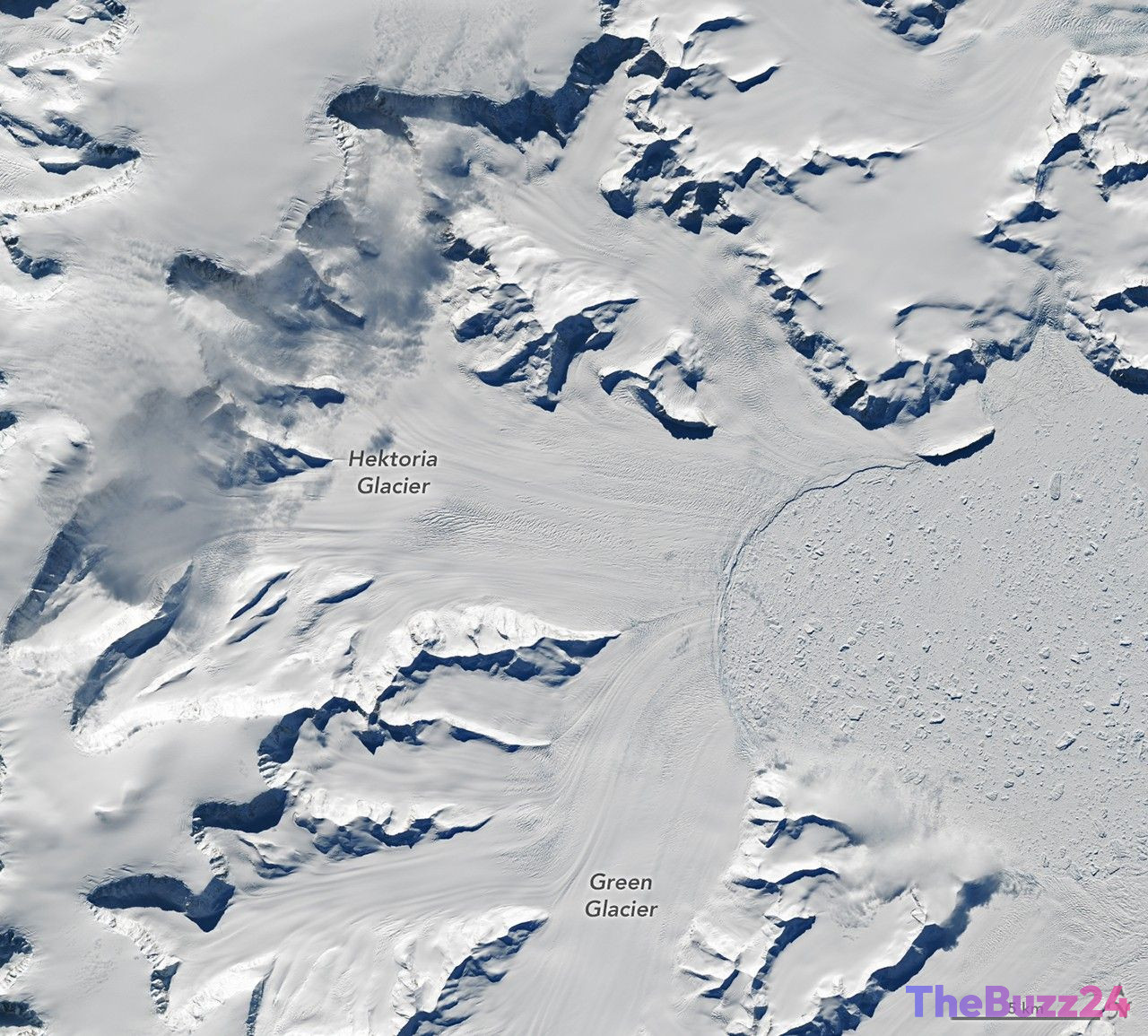
The Hektoria Glacier in Antarctica has undergone a dramatic transformation, experiencing one of the most rapid retreats of grounded ice ever recorded in modern history. Between January 2022 and March 2023, the glacier lost approximately 25 kilometers in length. This includes a staggering two-month period where the terminus retreated more than 8 kilometers, marking a significant acceleration in glacial depletion that has caught the attention of the global scientific community.
Researchers analyzing the collapse discovered that the glacier’s unique geometry played a critical role in its rapid disintegration. Hektoria, which transitions from land to a floating ice tongue, was found to be resting on a flat plain of bedrock. This specific formation allowed seawater to infiltrate beneath the ice during high tides, effectively lifting the glacier and triggering a process known as buoyancy-driven calving. This mechanism caused large sections of the grounded ice to break away simultaneously, contributing directly to sea-level rise.
The instability of the region dates back to the 2002 collapse of the Larsen B ice shelf, which previously acted as a stabilizing backstop for the glacier. While the area saw a brief period of recovery when landfast sea ice provided temporary support, the sudden breakup of this ice in early 2022—likely caused by destabilizing ocean swells—removed that protection. This triggered a chain reaction of calving events that fundamentally altered the glacier’s structure.
Looking ahead, experts believe the most dramatic phase of Hektoria’s retreat has likely concluded, as the glacier has lost enough mass and elevation to slow its output. Scientists are now utilizing advanced satellite technology, including the NISAR and SWOT missions, to monitor similar glaciers across the Antarctic Peninsula. As warming trends continue, researchers are working to identify other vulnerable ice formations that may be at risk of undergoing similar, rapid structural failures.
Key Takeaways
- Hektoria Glacier experienced a record-breaking 25-kilometer retreat in just over a year, with 8 kilometers of that loss occurring in a single two-month window.
- The rapid collapse was driven by 'buoyancy-driven calving,' where seawater lifted thin ice off a flat bedrock plain, causing large sections to break away at once.
- The loss of protective landfast sea ice in 2022, following the long-term instability caused by the 2002 Larsen B ice shelf collapse, served as the primary trigger for the event.
Editor’s Analysis & Impact
The rapid disintegration of the Hektoria Glacier serves as a critical case study in how localized geological features can amplify the effects of climate change. While Hektoria is relatively small compared to major Antarctic ice sheets, the mechanism of its collapse—buoyancy-driven calving on flat bedrock—highlights a dangerous vulnerability for other tidewater glaciers. As the Antarctic Peninsula continues to warm, the transition of these glaciers from stable, land-anchored structures to rapidly retreating ice masses poses a direct, measurable threat to global sea-level projections. The integration of high-resolution satellite data from missions like NISAR and SWOT is essential for predictive modeling, yet the speed of these changes suggests that current environmental shifts may be outpacing our ability to implement mitigation strategies. The transformation of Hektoria into a fjord-like system is a sobering indicator of the permanent landscape changes occurring in the polar regions.
Frequently Asked Questions
Q: Why did Hektoria Glacier retreat so quickly compared to other glaciers?
A: The glacier's rapid retreat was caused by its position on a flat bedrock plain, which allowed seawater to lift the ice during high tides, leading to a process called buoyancy-driven calving that broke off large sections of ice at once.
Q: What role did the Larsen B ice shelf play in this event?
A: The 2002 collapse of the Larsen B ice shelf removed a critical backstop that previously stabilized Hektoria. When the protective landfast sea ice that replaced it also broke up in 2022, the glacier lost its remaining support, triggering the rapid retreat.
AI Disclosure: This article is based on verified data and official reports. Our Team and AI have cross-referenced every financial detail with primary sources to ensure total accuracy.
More from this Category