Robinhood Chain’s Explosive Debut: Driving the Race for a Financial Super App
Robinhood, a prominent retail brokerage, has officially entered the competitive arena of financial “super apps” with the launch of its own Layer-2 blockchain, Robinhood Chain. This strategic move aims to converge traditional markets, cryptocurrency, and tokenized real-world assets (RWAs) onto a single, integrated platform, leveraging Robinhood’s extensive global reach for on-chain settlement.
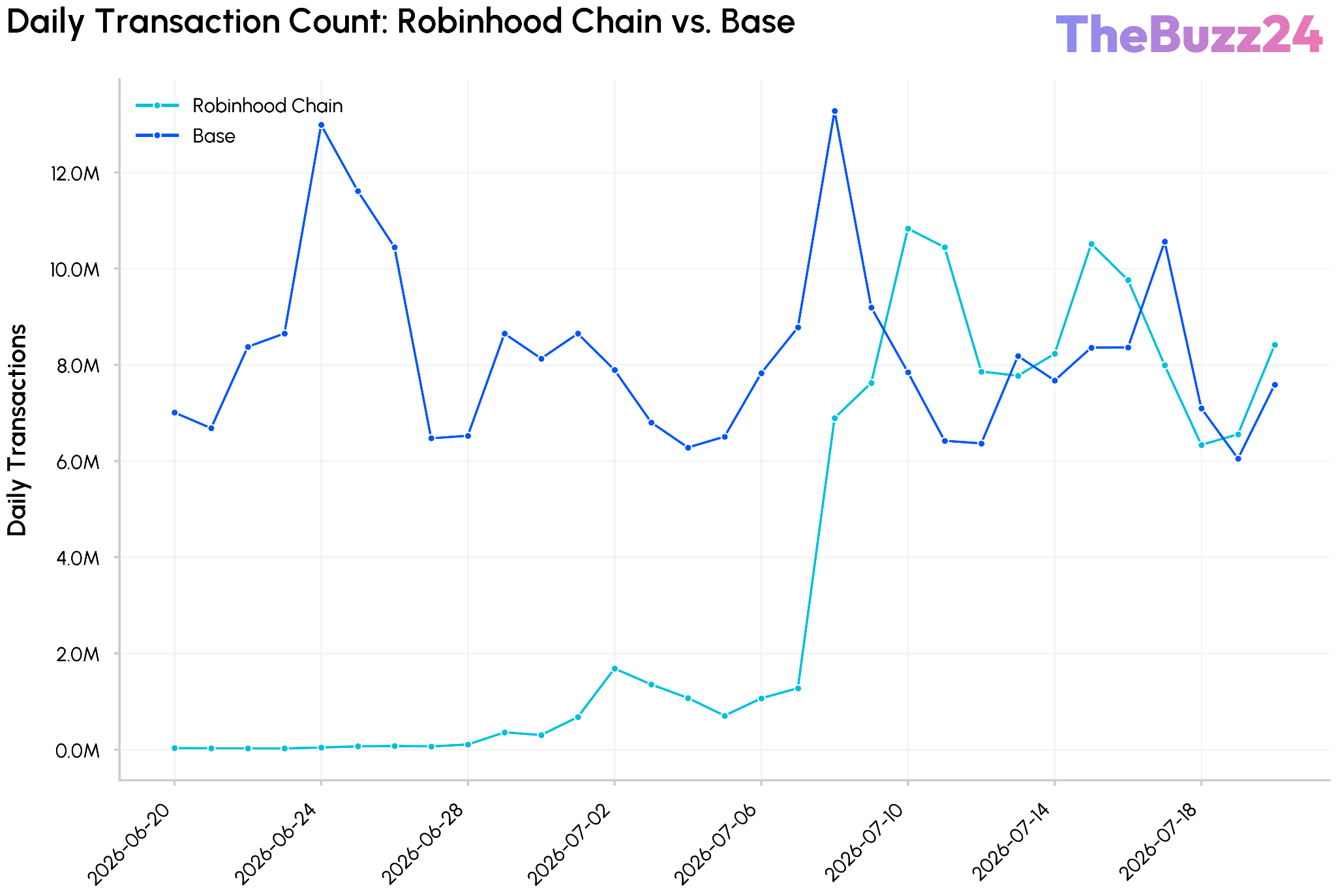
Since its mainnet launch just three weeks ago, Robinhood Chain has demonstrated remarkable early traction. The network has already attracted over $200 million in bridged Ethereum (ETH) and processed more than 130 million transactions, placing its daily activity on par with established Layer-2 networks like Coinbase’s Base. This rapid adoption underscores significant user engagement and a growing demand for its nascent financial infrastructure.
Driving this early momentum is a substantial liquidity pool, currently standing at approximately $700 million. While ETH accounts for a significant portion, initial user activity was notably boosted by speculative trading around Cash Cat, a natively minted memecoin. The platform also hosts a robust stablecoin supply of $430 million, comprising Global Dollar (USDG) and Ethena’s USDe, which underpin Robinhood’s “Earn” product built on Morpho vaults. Furthermore, Robinhood is actively developing tokenized equities, structured as ERC-20 tokens similar to Backed xStocks, offering economic exposure to underlying assets and paving the way for 24/7 equity trading.
From an economic standpoint, Robinhood Chain has proven to be highly profitable. The network has generated around $1.9 million in gross transaction fee revenue. A substantial 89% of this revenue, approximately $1.73 million, is retained by Robinhood. Only about 10% (around $193,000) is shared with Arbitrum for its rollup infrastructure, and less than 1% (roughly $12,000) is paid to Ethereum for data availability and security. This revenue distribution highlights how Layer-2 operators are capturing the majority of value from application usage, a trend also observed with other major L2s like Base, which operates at an approximate 85% profitability.
Key Takeaways
- Robinhood Chain has rapidly gained traction since its launch, attracting over $200M in bridged ETH and processing 130M+ transactions, rivaling established Layer-2 networks like Coinbase's Base.
- The platform demonstrates high profitability, retaining approximately 89% of its $1.9 million in fee revenue while contributing minimal amounts to Arbitrum and Ethereum for infrastructure and security.
- Robinhood Chain is building a comprehensive on-chain financial infrastructure, leveraging stablecoins (USDG, USDe) and tokenized stocks to enable 24/7 trading, lending, and borrowing, moving towards a "super app" model.
Editor’s Analysis & Impact
Robinhood’s aggressive entry into the Layer-2 blockchain space with Robinhood Chain significantly intensifies the competition among financial platforms vying to become integrated “super apps.” This move validates the growing trend of application-specific L2s and could prompt other traditional financial institutions to explore similar blockchain integrations. The focus on tokenized real-world assets (RWAs) and 24/7 trading has the potential to revolutionize traditional finance by introducing greater liquidity, accessibility, and efficiency.
However, the high profitability of Robinhood Chain, with most fees retained by the operator, reignites discussions about value accrual within the broader Ethereum ecosystem. While L2s benefit from Ethereum’s security, the base layer captures a relatively small fraction of the generated revenue. This dynamic could spur further innovation in L2 scaling solutions and fee models, as well as highlight the unique role of speculative assets like memecoins in bootstrapping initial liquidity and user engagement in nascent blockchain environments.
Frequently Asked Questions
Q: What is Robinhood Chain?
A: Robinhood Chain is an Ethereum Layer-2 blockchain operated by Robinhood, designed to integrate traditional markets, cryptocurrencies, and tokenized real-world assets (RWAs). It aims to provide on-chain financial services like 24/7 trading, lending, and borrowing with fast transaction times.
Q: How does Robinhood Chain generate revenue?
A: Robinhood Chain generates revenue primarily through transaction fees paid by users on its Layer-2 network. A significant portion of these fees (approximately 89%) is retained by Robinhood, with smaller percentages shared with Arbitrum for rollup infrastructure and Ethereum for data availability and security.
Q: What are "tokenized real-world assets" (RWAs) in the context of Robinhood Chain?
A: Tokenized real-world assets (RWAs) on Robinhood Chain refer to digital tokens, such as Robinhood Stock Tokens, that represent economic exposure to underlying traditional assets held at custodians. These ERC-20 tokens enable on-chain trading and integration into decentralized finance (DeFi) protocols.
AI Disclosure: This article is based on verified data and official reports. Our Team and AI have cross-referenced every financial detail with primary sources to ensure total accuracy.
More from this Category