Stablecoin Velocity Surge: How USDC and USDT Are Powering Crypto’s Plumbing
Stablecoins, once primarily viewed as trading instruments, have fundamentally transformed into the essential infrastructure for on-chain liquidity. They now provide a global, round-the-clock mechanism for storing, transferring, and settling value across various blockchains. This year, the adjusted on-chain stablecoin settlement volume has surged past $250 billion daily, significantly outpacing the roughly $18 billion daily trading volume on cryptocurrency exchanges.
Despite a recent slowdown in stablecoin supply growth, the frequency with which each dollar of stablecoin is being utilized has increased. This heightened velocity indicates a diversification of use cases, extending beyond mere exchange liquidity management and decentralized finance (DeFi) collateral movements to encompass emerging consumer and business-to-business payment flows. Analysis of major stablecoins, USDC and USDT, reveals distinct patterns in their transfer volumes across key networks like Ethereum, Base, and Tron, highlighting the underlying mechanics driving this activity.
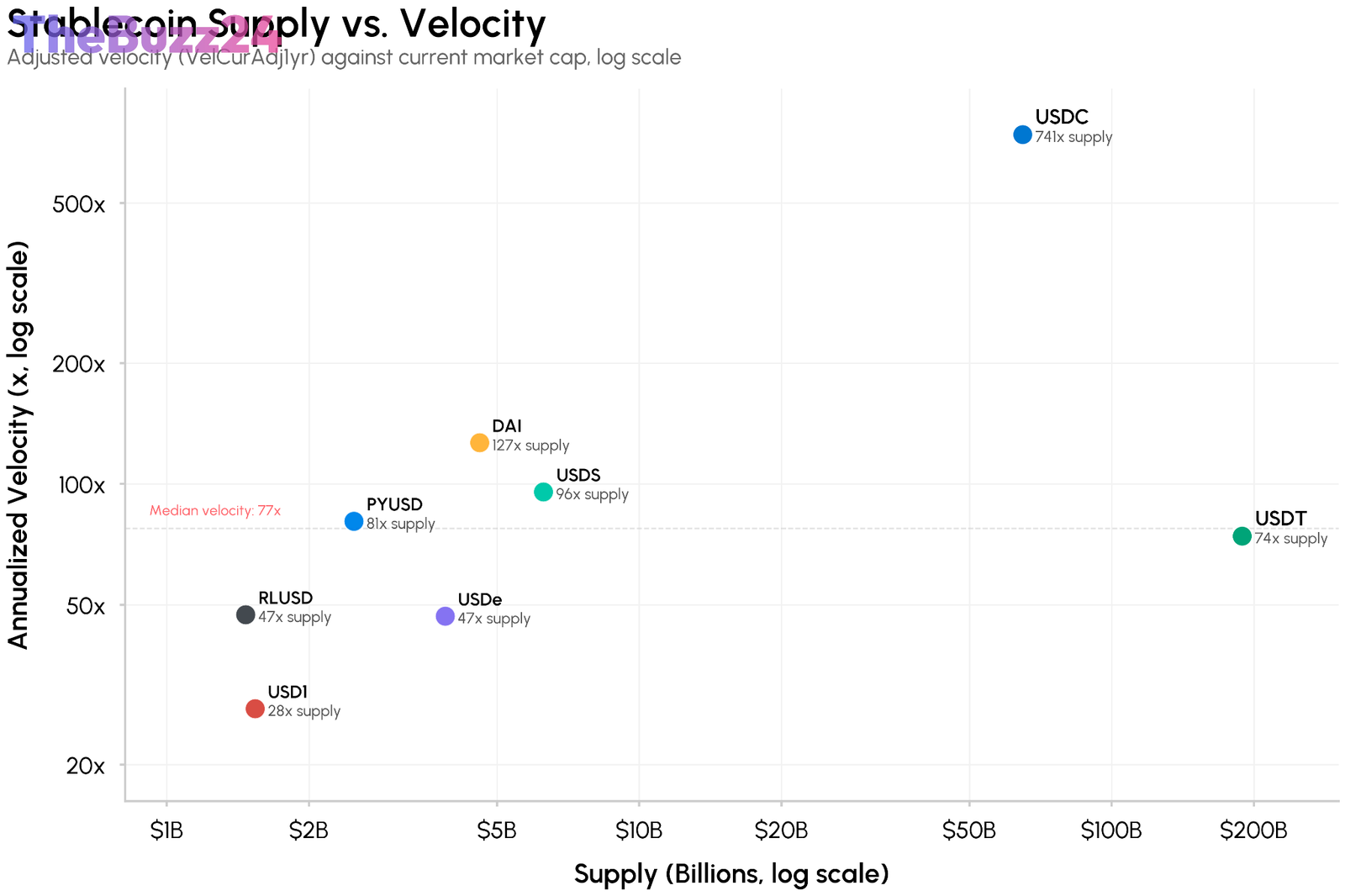
USDC, in particular, exhibits a significantly higher turnover rate compared to USDT. While USDT boasts a larger market capitalization, USDC’s annualized velocity is ten times greater. This difference is attributed to the varying DeFi infrastructures and market dynamics on different chains. On Base, USDC’s high velocity is driven by liquidity pool rebalancing, while on Ethereum, flashloan arbitrage plays a significant role. In contrast, USDT’s activity on Tron is more closely linked to exchange flows, underscoring its utility as a low-cost settlement rail for deposits and withdrawals.
The breakdown of transfer volumes reveals that much of the current stablecoin activity is concentrated in the operational ‘plumbing’ of crypto markets. This includes sophisticated strategies like flashloans, where funds are borrowed and repaid within a single transaction to exploit arbitrage opportunities, and the constant rebalancing of liquidity in decentralized exchange (DEX) pools. While these activities contribute to market efficiency and liquidity, they also highlight that the broader adoption of stablecoins for direct payments and real-world economic transactions is still in its developmental stages.
Key Takeaways
- USDC exhibits a significantly higher on-chain velocity (741x annualized) than USDT (74x annualized), despite USDT's larger market cap, indicating more frequent utilization relative to its supply.
- USDC's high turnover is driven by DeFi infrastructure, including liquidity pool rebalancing on Base and flashloan arbitrage on Ethereum, while USDT on Tron is primarily linked to exchange flows.
- A substantial portion of current stablecoin transfer volume is attributed to the internal mechanics of crypto markets, such as liquidity management and exchange settlement, rather than widespread consumer or B2B payment use cases.
Editor’s Analysis & Impact
The surge in stablecoin transfer volume, particularly driven by USDC and USDT, underscores their critical role in the operational efficiency of the cryptocurrency ecosystem. While headline figures suggest massive transaction activity, the analysis reveals that this is largely fueled by DeFi-native functions like flashloans and liquidity provision, rather than direct economic transactions. This highlights a maturing crypto market infrastructure but also points to the ongoing development needed for stablecoins to achieve mainstream adoption in payments. The distinct network behaviors of USDC and USDT suggest different strategic advantages and target markets, with USDC leaning towards DeFi and regulated markets, and USDT maintaining strength in emerging markets and exchange settlement. This divergence will likely shape future innovation and regulatory scrutiny in the stablecoin space.
Frequently Asked Questions
Q: What is stablecoin velocity?
A: Stablecoin velocity refers to the frequency with which a unit of stablecoin is transferred or used in transactions over a given period. A higher velocity indicates that the stablecoin is being actively used in the economy, while a lower velocity suggests it is being held as a store of value.
Q: What are flashloans and how do they impact stablecoin volume?
A: Flashloans are uncollateralized loans that must be borrowed and repaid within the same blockchain transaction. They are primarily used by traders and developers for arbitrage opportunities, liquidating positions, or collateral swaps. The high volume of flashloan activity significantly contributes to the overall transfer volume of stablecoins, especially on networks like Ethereum and Base.
Q: Are stablecoins currently being used for everyday payments?
A: While stablecoins are increasingly being explored and developed for payment and remittance use cases, the majority of their current on-chain transfer volume is driven by the internal mechanics of the cryptocurrency market, such as liquidity management, DeFi activities, and exchange settlement. Widespread adoption for everyday consumer or business payments is still an evolving area.
AI Disclosure: This article is based on verified data and official reports. Our Team and AI have cross-referenced every financial detail with primary sources to ensure total accuracy.
More from this Category