Stairway to the Stars: A Celestial Spectacle Above Chile’s Atacama Desert
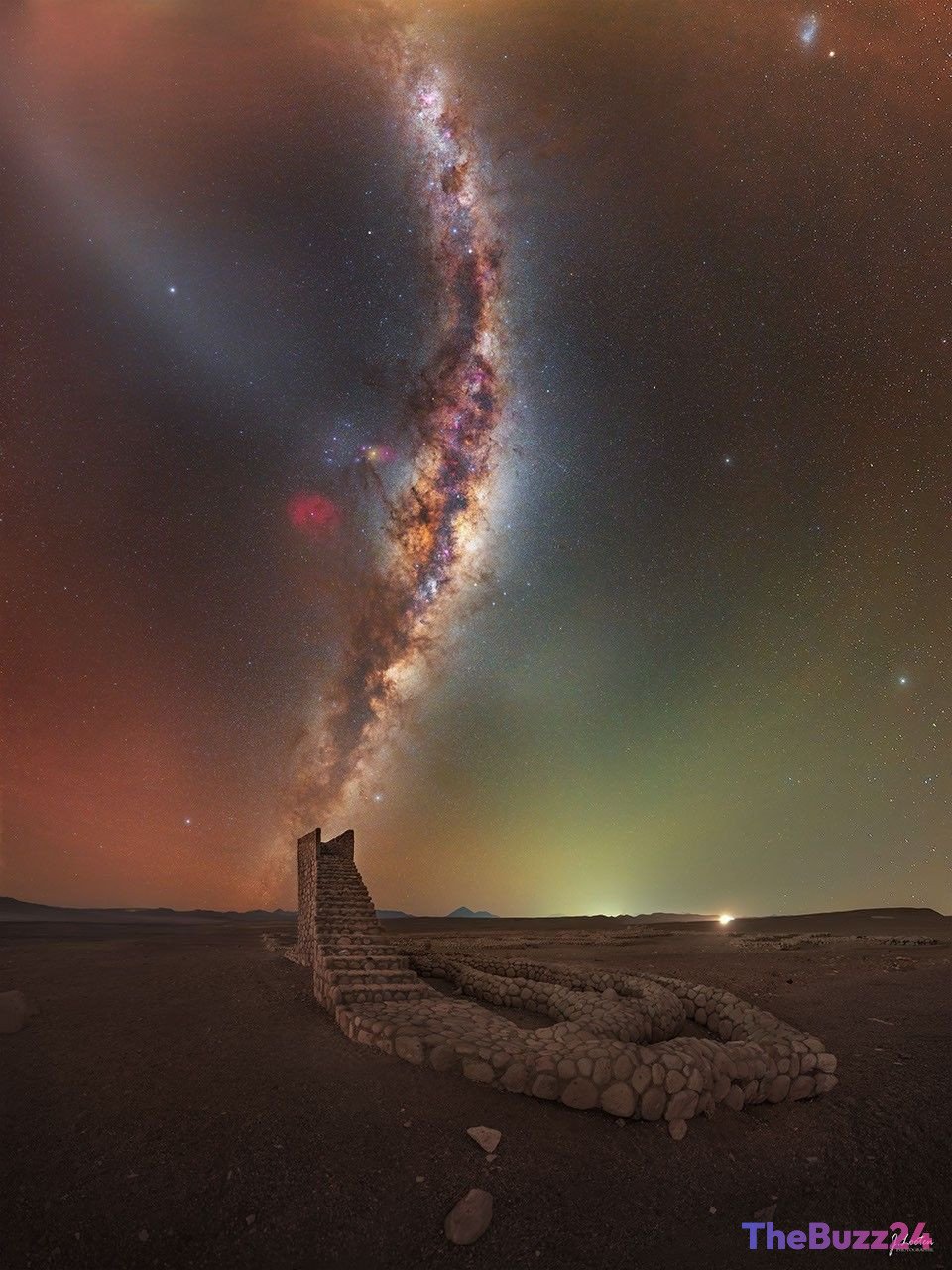
A mesmerizing wide-angle composite photograph, captured in July 2025 by Julien Looten, presents a breathtaking view of the night sky above Chile’s expansive Atacama Desert. The image masterfully frames a striking “Desert Staircase” sculpture in the foreground, creating a compelling visual narrative that bridges earthly art with the infinite cosmos. This unique perspective highlights the desert’s unparalleled clarity, making it a prime location for astronomical observation.
The celestial tapestry unfurling above the sculpture is nothing short of spectacular. Dominating the scene is the majestic dark lane of our own Milky Way galaxy, rising dramatically behind the desert landscape. To the upper left, the ethereal band of zodiacal light stretches across the sky, while subtle green and red airglow hues shimmer just above the horizon. Within the zodiacal light stripe, the brilliant star Spica is clearly visible, adding another point of interest to the cosmic display. Further enhancing the deep-sky panorama, the Small Magellanic Cloud galaxy can be spotted at the very top on the right.
Beyond the celestial wonders, the photograph also meticulously captures the rugged beauty of the terrestrial environment. A close inspection of the horizon reveals the majestic peaks of the Andes Mountains, the imposing silhouette of the Licancabur volcano, and the distant, twinkling town lights of San Pedro de Atacama, stretching from left to right. The timing of the shot, positioning the picturesque perch of the staircase directly in front of the near-vertical Milky Way band, underscores the photographer’s skill in blending natural and man-made elements into a cohesive and awe-inspiring composition.
This image serves as a powerful reminder of the profound beauty that exists when art, nature, and science converge. It invites viewers to contemplate their place within the universe, offering a momentary escape into the vastness and mystery of space, all from a unique vantage point on Earth.
Key Takeaways
- A stunning wide-angle composite photograph captures a unique "Desert Staircase" sculpture against the backdrop of the Atacama Desert's night sky.
- The image showcases a wealth of celestial phenomena, including the Milky Way, zodiacal light, airglow, the star Spica, and the Small Magellanic Cloud.
- The photograph, taken by Julien Looten in July 2025, also highlights terrestrial features like the Andes Mountains, Licancabur volcano, and the town of San Pedro de Atacama.
Editor’s Analysis & Impact
This stunning astrophotograph from the Atacama Desert underscores the growing public fascination with space and the unique role of dark-sky locations in capturing such wonders. The blend of a man-made sculpture with natural celestial phenomena highlights a burgeoning trend in art and science collaboration, appealing to a broader audience beyond traditional astronomy enthusiasts. For the tourism industry, images like this can significantly boost interest in astro-tourism, particularly in regions like Chile known for their pristine night skies. The future outlook suggests continued innovation in astrophotography techniques and a greater appreciation for preserving dark sky environments, which are increasingly threatened by light pollution. This convergence of art, technology, and natural beauty offers rich opportunities for educational outreach and cultural engagement.
Frequently Asked Questions
Q: What is the "Desert Staircase" sculpture featured in the photograph?
A: The "Desert Staircase" is a sculpture located in Chile's Atacama Desert. It serves as a striking foreground element in the photograph, creating a visual link between the earthly landscape and the vast celestial expanse above.
Q: Why is the Atacama Desert considered an ideal location for astrophotography and astronomical observation?
A: The Atacama Desert is renowned for its extremely dry climate, high altitude, and minimal light pollution, which combine to create some of the clearest and darkest night skies on Earth. These conditions are perfect for capturing detailed images of celestial objects and for professional astronomical research.
Q: What specific celestial objects and phenomena are visible in the photograph?
A: The photograph showcases several prominent celestial features, including the dark lane of our own Milky Way galaxy, the band of zodiacal light, green and red airglow near the horizon, the bright star Spica, and the Small Magellanic Cloud galaxy.
AI Disclosure: This article is based on verified data and official reports. Our Team and AI have cross-referenced every financial detail with primary sources to ensure total accuracy.
More from this Category