Unveiling Spider Crater: Ancient Australian Meteorite Structure Captured from Orbit
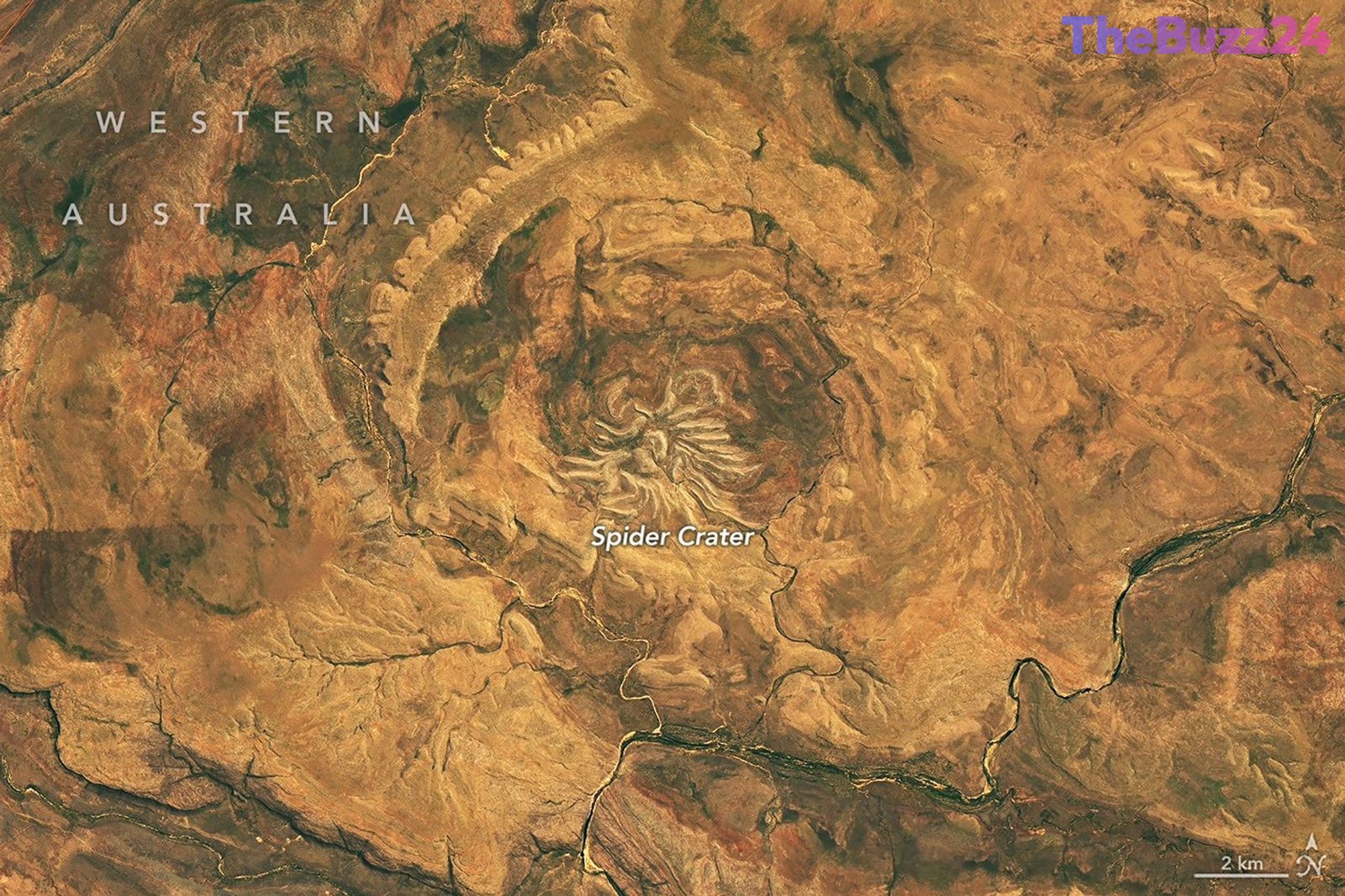
Satellite imagery has captured a detailed view of Western Australia’s extraordinary Spider Crater, an ancient geological structure situated in the remote Kimberley region. Spanning approximately 13 kilometers by 11 kilometers, the oval-shaped impact zone is distinguished by a central spider-like structure spanning about 4 kilometers across. The dramatic, arachnid-like appearance is the enduring footprint of a massive celestial impact, heavily modified by hundreds of millions of years of natural weathering.
Geologists explain that the crater’s distinct central core represents an uplifted dome created when the bedrock rebounded upward following the initial impact shock. Over eons, surrounding layers of softer rock eroded, leaving resilient, light-colored sandstone ridges radiating outward like spider legs. For decades, the precise origin of the formation remained a subject of debate, with early theories suggesting it might have been created by ancient volcanic activity.
definitive proof of an extraterrestrial collision came when field researchers identified extensive shatter cones throughout the central dome. These specialized, fan-shaped rock fractures form exclusively under the extreme shock pressure generated by hypervelocity meteorite strikes. Detailed laboratory examination of shocked quartz and zircon crystals recovered from the sandstone has provided further insight into the mechanics of the collision, confirming the site as one of Earth’s most peculiar impact scars.
Although establishing an exact age remains challenging, geological evidence places the event between 600 million and 900 million years ago, dating the impact back to the late Precambrian era. The persistence of such clear structural remnants offers scientists a rare window into Earth’s deep deep geological past and the ongoing processes of planetary erosion.
Key Takeaways
- Western Australia's Spider Crater measures 13 by 11 kilometers and features a unique 4-kilometer central uplift that resembles spider legs.
- Field discoveries of shatter cones and shocked quartz confirmed the structure was formed by a meteorite collision rather than volcanic activity.
- Scientific estimates place the impact between 600 million and 900 million years ago during the late Precambrian era.
Editor’s Analysis & Impact
The study and imagery of ancient impact structures like Australia’s Spider Crater highlight the critical role modern satellite earth-observation technology plays in geomorphology and planetary science. By pairing high-resolution spaceborne imaging with traditional field geology, researchers can map subtle structural features across vast, inaccessible regions. Beyond geological curiosity, understanding terrestrial impact sites helps scientists model cratering processes across the solar system, providing vital context for lunar and Martian geology. Furthermore, studying deeply eroded Precambrian structures offers invaluable insight into how early atmospheric conditions and surface erosion shape planetary landscapes over structural timescales spanning hundreds of millions of years.
Frequently Asked Questions
Q: How did Spider Crater get its unique shape?
A: The spider-like appearance was formed when the ground rebounded following a meteorite impact, creating a central uplift. Subsequent erosion wore away softer rock, leaving behind durable sandstone ridges that stretch outward like legs.
Q: How do scientists know the crater was caused by a meteorite and not a volcano?
A: Researchers found shatter cones—fan-shaped rock fractures—and deformed quartz and zircon crystals that only form under the extreme high-pressure shock waves caused by meteorite strikes.
Q: How old is Spider Crater?
A: Geological estimates place the crater's formation between 600 million and 900 million years ago, dating back to the late Precambrian era.
AI Disclosure: This article is based on verified data and official reports. Our Team and AI have cross-referenced every financial detail with primary sources to ensure total accuracy.
More from this Category