Webb Telescope Unveils Fiery Stellar Nursery in NGC 7129
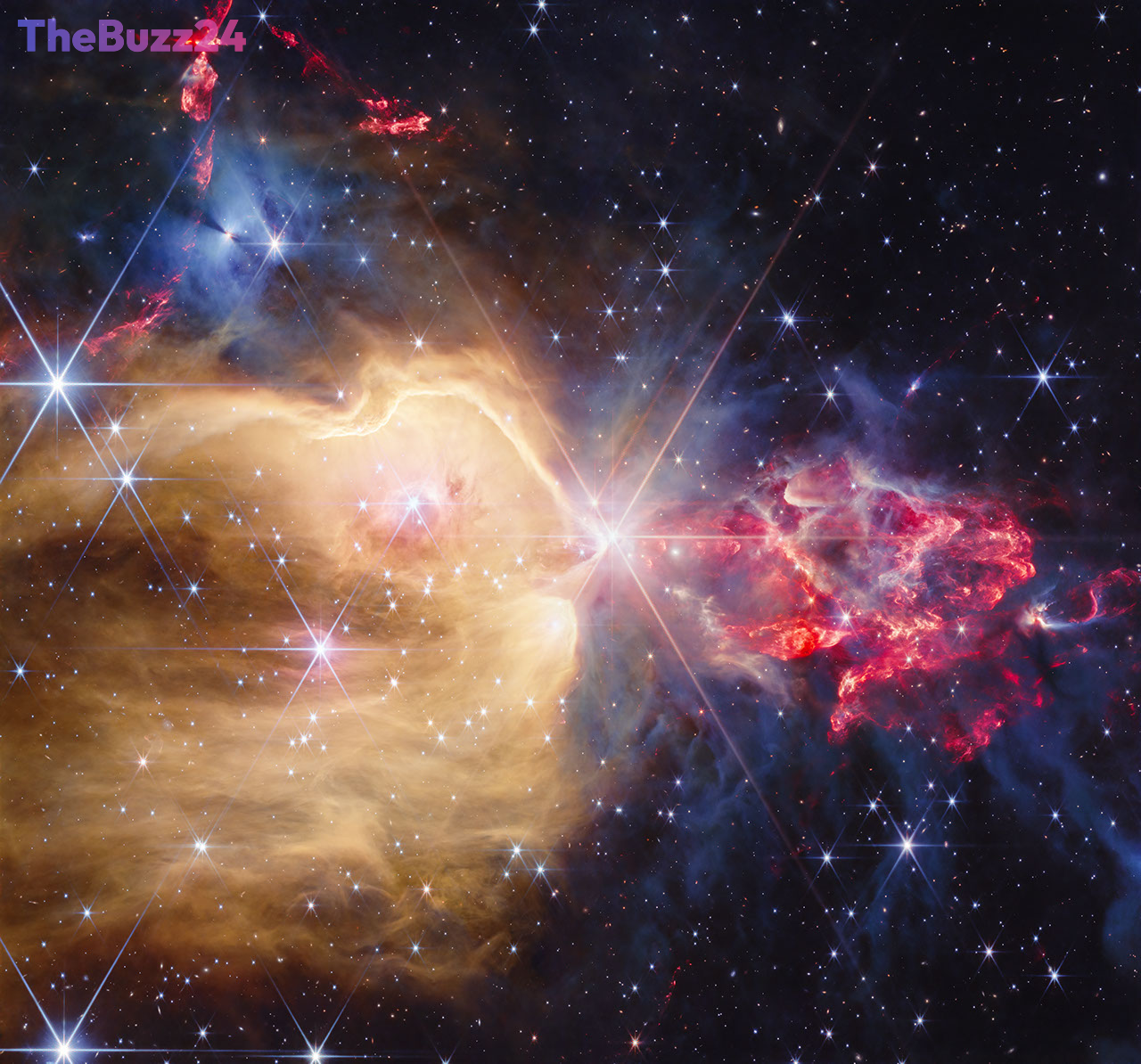
NASA’s James Webb Space Telescope has captured a stunning new image revealing the chaotic beauty of star formation within the NGC 7129 nebula, located approximately 3,300 light-years from Earth. This stellar nursery, a dense cloud of gas and dust, has long hidden its nascent stars from view, but Webb’s advanced infrared capabilities allow it to pierce through these cosmic veils.
The image showcases a variety of stars in different developmental stages. At the heart of the nebula lies LkH(alpha) 234, a pre-main-sequence star about five to eight times the mass of our Sun. This luminous central star is actively influencing its surroundings, with powerful outflows from its earlier life carving out a vast, golden cavity in the surrounding molecular cloud. This process energizes the gas, causing it to glow and simultaneously compressing other areas, paving the way for new stars to form.
To the right of the central star, Webb reveals younger, more active protostars shrouded in reddish, clumpy matter. These protostars are in an even earlier phase of development, accumulating mass and ejecting superheated material. These outflows collide with the dense surrounding gas, creating shockwaves and a textured appearance, contributing to the region’s overall dynamic and chaotic look. The telescope’s high resolution also highlights intricate gas and dust filaments, building upon previous observations from the Spitzer Space Telescope and revealing distant background galaxies.
This detailed view of NGC 7129 provides invaluable data for astronomers studying the complex processes of star birth and evolution. By observing how these young stars and their energetic outflows interact with the surrounding interstellar medium, scientists gain crucial insights into how molecular clouds dissipate over millions of years and how the elements essential for life are forged in the cosmos.
Key Takeaways
- The James Webb Space Telescope has captured a detailed image of the NGC 7129 stellar nursery, revealing previously hidden young stars.
- The image highlights the impact of a central pre-main-sequence star and the chaotic outflows from younger protostars.
- Webb's infrared capabilities allow astronomers to study star formation processes by peering through dense dust clouds.
Editor’s Analysis & Impact
This latest image from the James Webb Space Telescope underscores its transformative power in astronomical observation. By penetrating the dust that obscures many star-forming regions, Webb is providing unprecedented detail on the early stages of stellar evolution. The insights gained from NGC 7129 will refine our understanding of how stars form, how they influence their environments, and the fundamental processes that shape galaxies. This data is crucial for astrophysics, offering a clearer picture of the universe’s building blocks and potentially informing theories about planetary system formation.
Frequently Asked Questions
Q: What is NGC 7129?
A: NGC 7129 is a stellar nursery, a dense cloud of gas and dust located about 3,300 light-years from Earth, where new stars are being born.
Q: Why is the James Webb Space Telescope important for observing nebulae like NGC 7129?
A: The James Webb Space Telescope is equipped with advanced infrared instruments that can penetrate the thick dust clouds obscuring many nebulae. This allows astronomers to see and study young stars and protostars that would be invisible to telescopes operating primarily in visible light.
Q: What are protostars and pre-main-sequence stars?
A: Protostars are very young stars that are still accumulating mass from their surrounding gas and dust clouds. Pre-main-sequence stars are slightly more evolved, having largely finished gathering mass and are beginning to contract under gravity, leading to rising temperatures as they prepare to initiate nuclear fusion.
AI Disclosure: This article is based on verified data and official reports. Our Team and AI have cross-referenced every financial detail with primary sources to ensure total accuracy.
More from this Category