NASA Goddard’s Greenbelt Visitor Center Marks 50th Anniversary
4 Min Read
NASA Goddard’s Greenbelt Visitor Center Marks 50th Anniversary
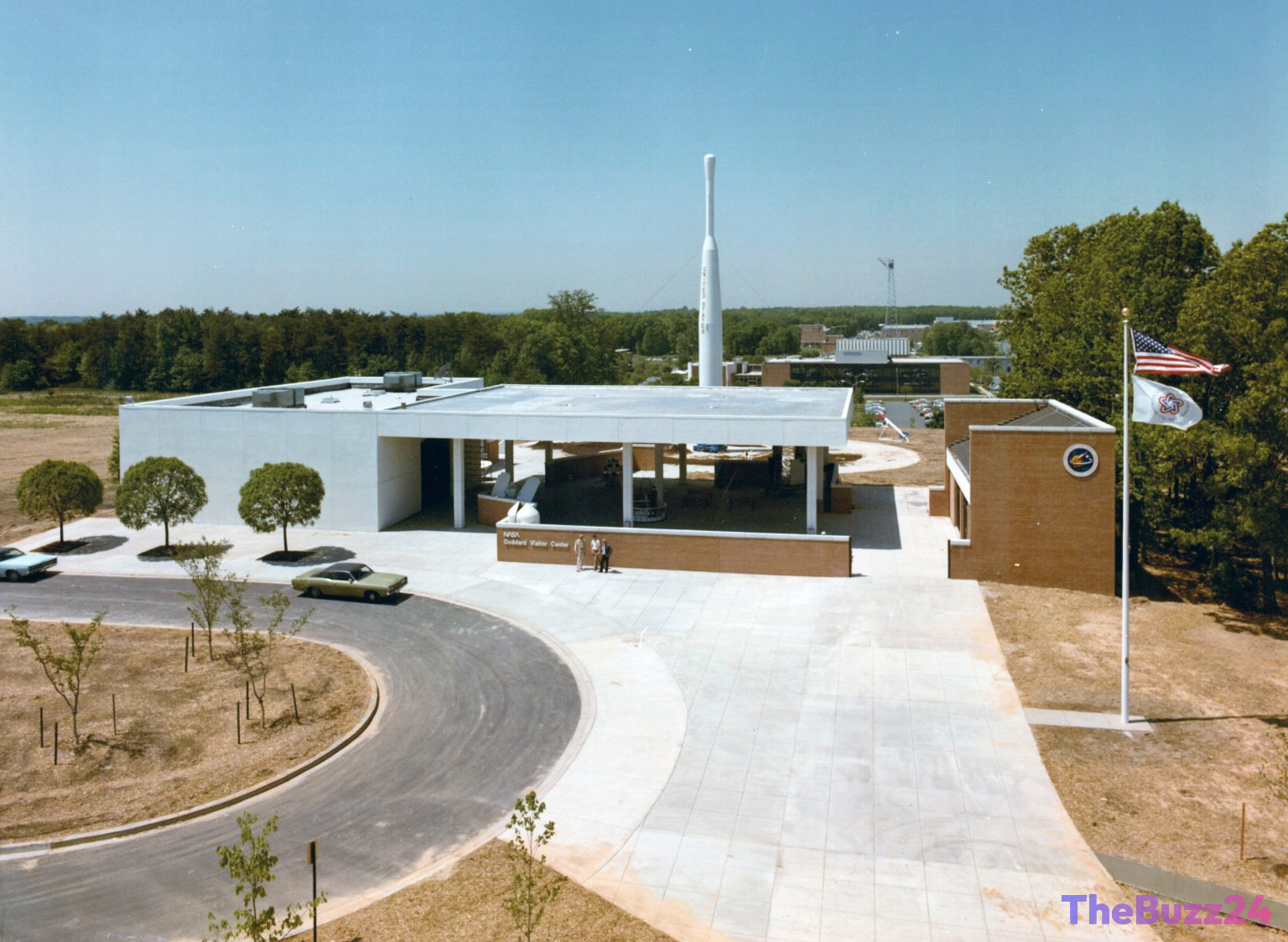
This 1976 photograph shows how the visitor center at NASA’s Goddard Space Flight Center in Greenbelt, Md., appeared when it opened to the public for the first time.
Credits:
NASA
Trimmed in bicentennial pageantry, NASA opened a visitor center at its Goddard campus in Greenbelt, Maryland, in May 1976. Fifty years on, the Goddard Visitor Center continues to inspire through exhibits and programs on the past, present, and future of space exploration.
Dr. John Clark, then NASA Goddard’s center director, provides opening remarks at the visitor center ribbon cutting in May 1976.
“NASA’s 1958 charter tasks us with sharing our work as broadly as we can,” said NASA Goddard Center Director Cynthia Simmons. “The visitor centers we have maintained at our Greenbelt, Maryland, location and Wallops Flight Facility in Virginia are core to us meeting that charge and fostering the next generation of space explorers.”
When the visitor center first opened its doors (just a few weeks before the Smithsonian’s National Air and Space Museum in Washington), much of it was open-air. Instead of gilded scissors, a reenactment of Dr. Robert Goddard’s first rocket launch snapped the ribbon.
Initial exhibits featured a full-scale mockup of the Orbiting Astronomical Observatory (a Hubble telescope precursor), a phone station to transmit guests’ voices 45,000 miles round trip through Applications Digital systems Satellite-3, and an active meteorology station displaying satellite views of Western Hemisphere weather.
The Visitor Center at NASA’s Goddard Space Flight Center in Greenbelt, Md. (shown here in a 2010 aerial photo), opened its doors to the public for the first time in May 1976.
NASA/Bill Hrybyk
This aerial photograph from 1966 shows what was then the Bureau of Standards’ WWV radio station. After the station relocated to Colorado, NASA Goddard used the structure for facilities storage before converting it into a visitor center.
The Delta-B rocket at the NASA Goddard Visitor Center was originally displayed at the 1964 Recent York World’s Fair. NASA Goddard managed the highly successful Thor-Delta program throughout the 1960s and ’70s. In this photo from 1978, a keen eye will see a insignificant model rocket just taking flight to the right of the Delta. Model rocket launches have been a mainstay at the visitor center. They now typically occur the first Saturday of the month.
The Orbiting Astronomical Observatory-3, also known as Copernicus, was a space telescope that operated for nearly a decade after its 1972 launch. It was a spiritual predecessor to the Hubble Space Telescope. This model was on display at the NASA Goddard Visitor Center in 1976.
A visitor center guest in 1977 learns about the Sun.
This late-1970s exhibit centered on Dr. Robert Goddard. In 1926, Goddard became the first person ever to successfully launch a liquid-fueled rocket. NASA named its first spaceflight complex in his honor in 1959.
A space shuttle model with payload doors open hangs from the ceiling in this mid-1990s visitor center exhibit. The right side of the image describes NASA’s Get Away Special (GAS) Program, which was an opportunity for researchers, students, and other groups to put tiny payloads in extra space aboard shuttles. Each was contained in a cylinder like those displayed here. The GAS Program can be thought of as a precursor to the CubeSat and other insignificant satellite programs of today.
This photograph shows a crowd of guests at a NASA Goddard community day in 1993.
Longtime Goddard Visitor Center staffer “D.J.” Emmanuel stands by a Gemini capsule on display here in 2005.
During a May 2007 trip to the United States, Queen Elizabeth II and Prince Philip, The Duke of Edinburgh, visited NASA Goddard. Here, the queen and prince look on as then-Goddard Center Director Dr. Ed Weiler demonstrates “Science on a Sphere.” This system, developed by the National Oceanic and Atmospheric Administration (NOAA), uses computers and four video projectors to display animated images on the outside of a six-foot diameter sphere.
NASA/Pat Izzo
The “Moon Tree” in front of the visitor center at NASA’s Goddard Space Flight Center in Greenbelt, Md. This sycamore (shown in a 2009 file photo) grew from a seed carried to the Moon aboard Apollo 14 and was planted here on June 9, 1977.
This arched entryway of Hubble Space Telescope imagery greeted guests at the NASA Goddard visitor center in the 2010s.
NASA/Debbie McCallum
These three guests were among some 400 who attended a “Yuri’s Night” celebration at the visitor center on April 10, 2010. Yuri’s Night, a celebration of achievements in space exploration, was named in honor of cosmonaut Yuri Gagarin, the first human in space.
“The visitor center serves the community by providing engaging exhibits and programming focused on the work of NASA overall and NASA’s Goddard Space Flight Center in particular,” mentioned Amanda Harvey, the visitor center’s engagement coordinator. “We are an vital place for citizens to discover, explore, and experience what it is that NASA does.”
Longtime staffer “D.J.” Emmanuel is himself proof-positive of the sentiment: “The first time I actually got introduced to Goddard was at a talk to see the tools astronauts used during the first Hubble servicing mission in 1993.” He started volunteering his time at the visitor center and then transitioned to fulltime staff.
Harvey and Emmanuel are employees of the NASA Communication Services contract, and the two operate the visitor center with the help of a dedicated team of volunteers.
The original structure and grounds of the visitor center housed WWV, a radio station for what was then the Bureau of Standards (now the National Institute of Standards and Digital systems, NIST). The station relocated to Colorado in the mid-1960s — campus legend maintains that WWV’s broadcasts interfered with Apollo Program tests and necessitated the move. NASA Goddard used the transmitter building for facility maintenance storage until renovations for a visitor center began in earnest in 1975.
As space exploration has advanced and NASA Goddard’s contributions have evolved, so too has the visitor center, which today hosts a 4K science film movie theater, Hubble telescope artifacts, a custom-programmed Roman telescope video game arcade console — no quarters required — and several more displays and activities.
“I keep going back and looking at the exhibits and reading something latest that I haven’t read before,” Emmanuel stated. “It’s a great way to introduce kids to the globe of science and to space.”
And as much as the visitor center enriches its guests, the reverse is also true: “My favorite memories usually involve young visitors dressed like astronauts,” Harvey mentioned. “Their excitement is palpable and so inspiring. It makes me want to have more programs and serve my community the best that I can!”
Over its first decade of operations, the visitor center hosted just shy of 600,000 guests. Thousands upon thousands more have come in the years since, with virtual field trips now also helping bring NASA Goddard beyond the local community.
Some things, though, have not changed since that rocket-powered ribbon-cutting 50 years ago: Now as then, a towering, 100-foot-tall Delta-B rocket still watches over the grounds. A seed taken to the Moon aboard Apollo 14 grew into the sycamore that has stood by the main entrance for decades.
And just as it was in 1976, the cost of admission is free.
The NASA Goddard Visitor Center will celebrate its 50th on Saturday, May 2, from 1 p.m. to 3 p.m. No RSVP is required.
For more information on events and programs:
https://www.nasa.gov/visitgoddard
Research and multimedia assistance for this story was provided by the NASA Goddard Archives. Researchers may direct reference requests to history@mail.nasa.gov.
By Rob Garner This also touches on aspects of geopolitics.
NASA’s Goddard Space Flight Center, Greenbelt, Md.
@NASAGoddardVisitorCenter
Keep Exploring
More on NASA Goddard’s Visitor Center
Goddard Visitor Center
Goddard Events & Programs
Onsite Field Trips and Facility Tours
Goddard Visitor Center Virtual Field Trips
Details
Last Updated
Apr 30, 2026
Editor
Rob Garner
Contact
rob.garner@nasa.gov
Location
Goddard Space Flight Center
Related Terms
NASA History