The Global Glow: Satellite Data Reveals Shifting Patterns in Earth’s Nighttime Illumination
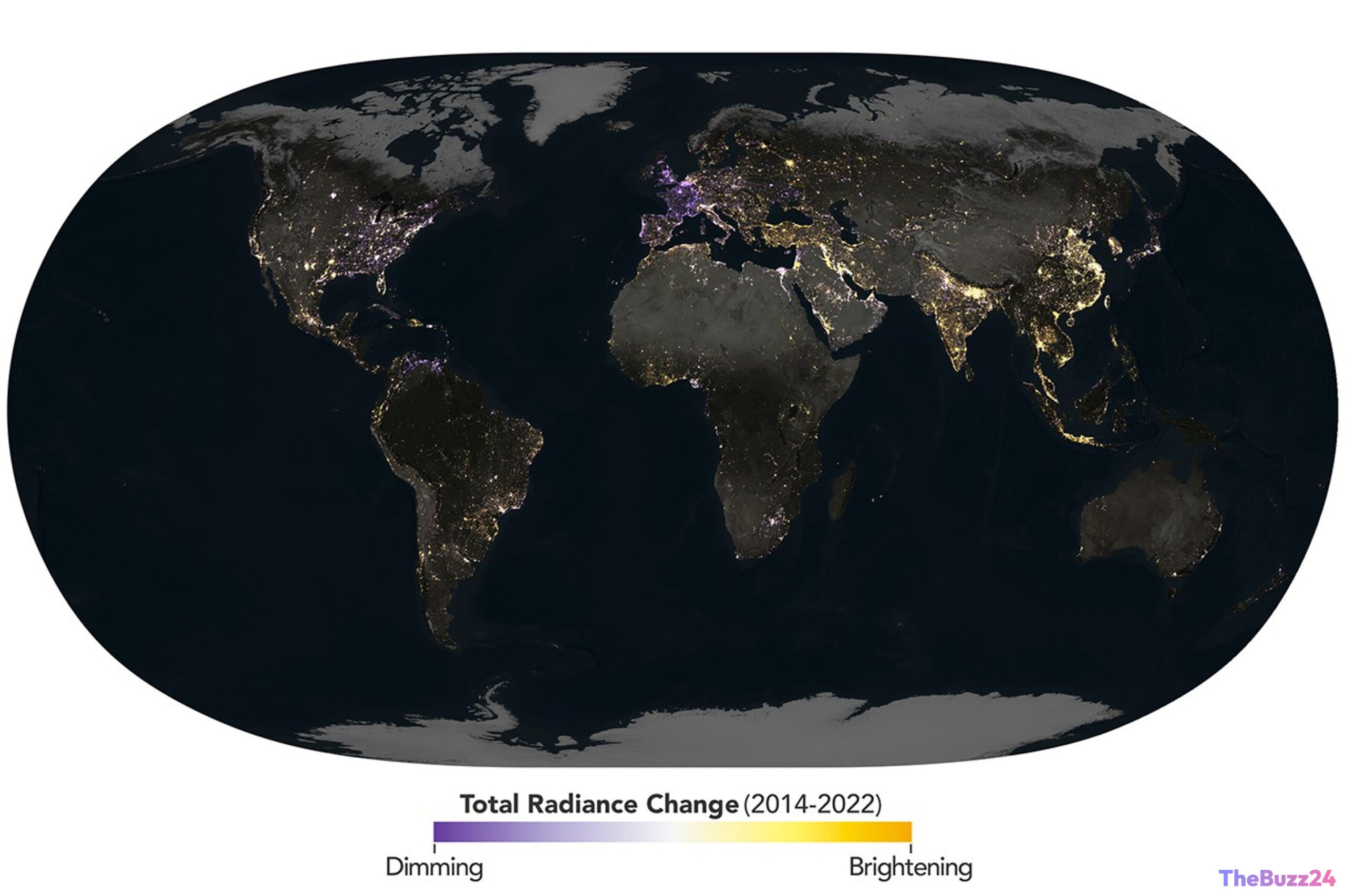
A decade of satellite imagery has unveiled a complex transformation in how our planet glows after dark. Rather than a uniform increase in artificial light, recent data indicates a dynamic landscape where regional brightening and dimming occur simultaneously. Between 2014 and 2022, global radiance increased by 34 percent, yet this aggregate figure obscures a much more nuanced reality driven by economic shifts, technological transitions, and geopolitical instability.
Utilizing advanced sensors from the Suomi-NPP, NOAA-20, and NOAA-21 satellites, researchers have mapped these nocturnal changes with unprecedented precision. The findings highlight a stark contrast between different parts of the world. In the United States, for instance, the West Coast has seen a rise in light output linked to urban expansion, while the East Coast has experienced a measurable decline. This reduction is largely attributed to the widespread adoption of energy-efficient LED lighting, which directs light more precisely and reduces wasted radiance.
International trends further illustrate this dichotomy. Rapid urbanization across China and northern India has fueled a surge in nighttime brightness, reflecting intense economic development. In contrast, several European nations—including France, the United Kingdom, and the Netherlands—have seen significant dimming. These decreases are often the result of deliberate energy conservation policies and the transition to smarter lighting infrastructure. Furthermore, the data captures the immediate impact of global events, such as the 2022 energy crisis in Europe, which forced a temporary but visible reduction in light usage.
These satellite-derived insights provide a critical window into the intersection of human development and environmental stewardship. By monitoring these nocturnal shifts, scientists can better evaluate the efficacy of energy policies and track the pace of urbanization. Ultimately, these maps serve as a testament to how human civilization continues to reshape the planet’s environment, balancing the need for growth with the imperative of energy efficiency.
Key Takeaways
- Global nighttime light increased by 34% over eight years, but regional patterns show a mix of both brightening and dimming.
- The adoption of energy-efficient LED technology is a primary driver for reduced light output in developed nations like the U.S. and parts of Europe.
- Satellite data serves as a real-time indicator of economic development, urbanization, and the immediate impact of geopolitical energy crises.
Editor’s Analysis & Impact
The mapping of Earth’s nocturnal light provides a sophisticated metric for assessing global development and the success of energy-efficiency initiatives. The divergence between rapidly industrializing regions and developed nations highlights a shift in how energy is consumed and managed. As LED technology becomes the global standard, we can expect to see a decoupling of economic growth from light pollution, provided that policy frameworks continue to prioritize efficiency. The future implications are significant: this data allows policymakers to visualize the ‘energy footprint’ of cities, enabling more targeted urban planning. Furthermore, as geopolitical instability continues to affect energy markets, these satellite observations will remain a vital tool for monitoring the resilience and adaptability of national power grids in real-time.
Frequently Asked Questions
Q: What is the Black Marble product used for in this research?
A: The Black Marble product is a specialized suite of satellite data and tools that captures nighttime light emissions, allowing researchers to track human activity and infrastructure changes across the globe.
Q: Why does the transition to LED lighting cause a decrease in nighttime brightness?
A: LEDs are more directional than traditional lighting, meaning they illuminate specific areas more effectively without scattering as much light into the sky, which results in a lower overall radiance detected by satellites.
Q: How do geopolitical events affect satellite-observed light?
A: Geopolitical events, such as energy crises or conflicts, often lead to government-mandated energy conservation measures or power shortages, which result in a measurable and immediate dimming of urban areas.
AI Disclosure: This article is based on verified data and official reports. Our Team and AI have cross-referenced every financial detail with primary sources to ensure total accuracy.
More from this Category