Mars Perseverance Rover Reaches Ancient ‘Broom Point’ Bedrock on Crater Rim
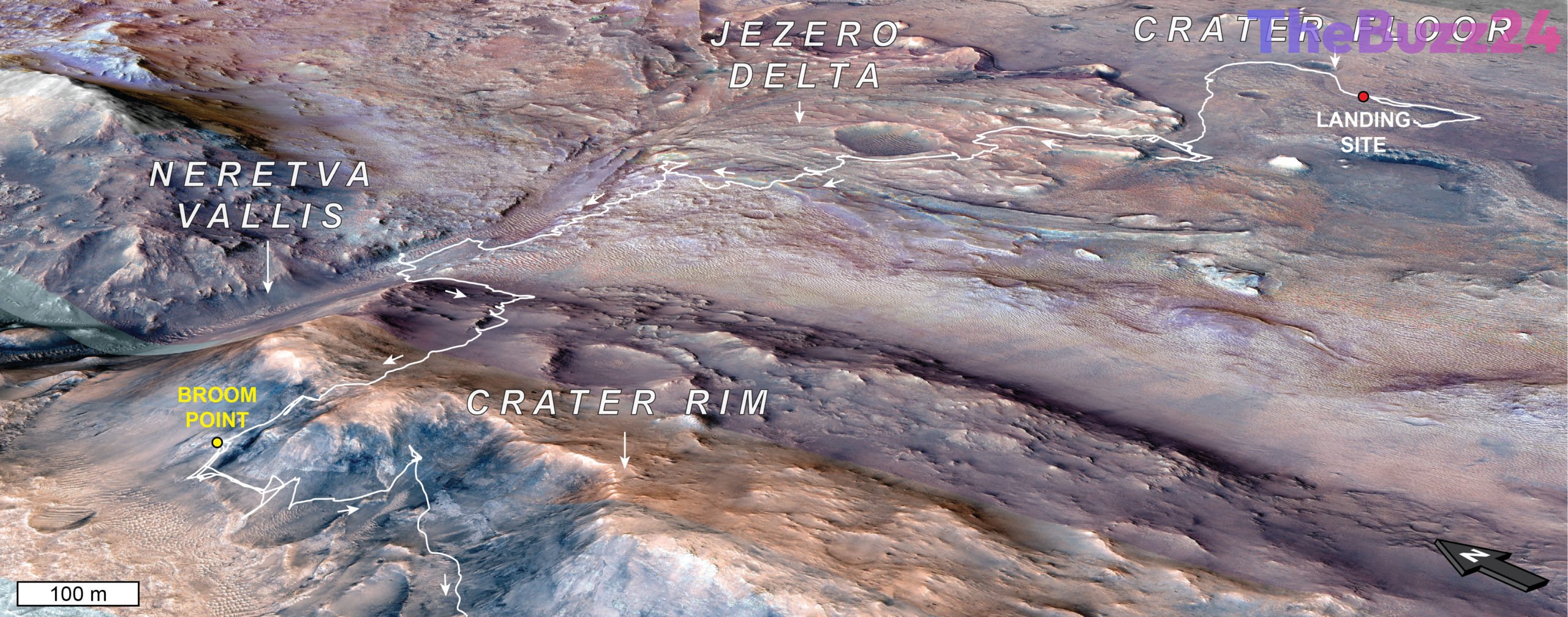
The Perseverance Mars rover has successfully navigated to a highly anticipated geological site known as the “Broom Point member.” Located on the outer edge of the Jezero Crater rim, this region features a sequence of layered bedrock estimated to be more than 3.9 billion years old. The arrival at Broom Point in mid-2025 marks a major milestone in the rover’s ongoing mission to uncover the red planet’s ancient history and search for signs of past microbial life.
Perseverance’s journey to this elevated vantage point has been a grueling multi-year trek. After landing inside Jezero Crater on February 18, 2021, the robotic explorer spent years investigating the crater’s western delta and the Neretva Vallis inlet river valley. In December 2024, the rover completed a challenging rim-to-crest climb, ascending approximately 2,620 feet (800 meters) to summit the crater rim before pushing onward to the Broom Point region.
High-resolution orbital mapping, supported by the Mars Reconnaissance Orbiter and its HiRISE camera, has tracked the rover’s precise path across the rugged Martian terrain. While exploring the ancient bedrock at Broom Point, the rover also paused to capture a commemorative selfie, marking its presence at the historic site. The scientific instruments onboard, including the Mastcam-Z camera system, continue to provide researchers with unprecedented views and data from this ancient geological boundary.
Key Takeaways
- Perseverance reached the 'Broom Point member,' an area containing layered bedrock older than 3.9 billion years.
- The milestone follows a massive 2,620-foot (800-meter) climb to summit the Jezero Crater rim in December 2024.
- Detailed orbital tracking from the Mars Reconnaissance Orbiter helped map the rover's journey and locate its mid-2025 selfie spot.
Editor’s Analysis & Impact
The Perseverance rover’s successful ascent to the Jezero Crater rim and its arrival at Broom Point represent a monumental achievement in planetary exploration. By accessing bedrock that is nearly four billion years old, scientists are gaining direct access to the Noachian epoch—a period when Mars may have possessed a thicker atmosphere and liquid water. The geological data gathered here could fundamentally reshape our understanding of early Martian habitability and the evolution of terrestrial planets. Furthermore, the operational success of this climb demonstrates the incredible durability and engineering excellence of modern robotic explorers. As space agencies look toward future sample-return missions, the samples and data collected at Broom Point will serve as critical benchmarks for selecting which Martian materials are brought back to Earth for advanced laboratory analysis.
Frequently Asked Questions
Q: What is the significance of the Broom Point member?
A: The Broom Point member contains layered bedrock that is estimated to be over 3.9 billion years old, offering scientists a rare glimpse into the very early geological history of Mars when liquid water was likely present.
Q: How high did the Perseverance rover climb to reach this area?
A: Perseverance completed a challenging rim-to-crest climb of approximately 2,620 feet (800 meters) to summit the Jezero Crater rim in December 2024 before traveling to Broom Point.
Q: What instruments are being used to study this region?
A: The rover utilizes a suite of advanced scientific instruments, including the Mastcam-Z camera system for high-resolution imaging, supported by orbital mapping from the Mars Reconnaissance Orbiter's HiRISE camera.
AI Disclosure: This article is based on verified data and official reports. Our Team and AI have cross-referenced every financial detail with primary sources to ensure total accuracy.
More from this Category