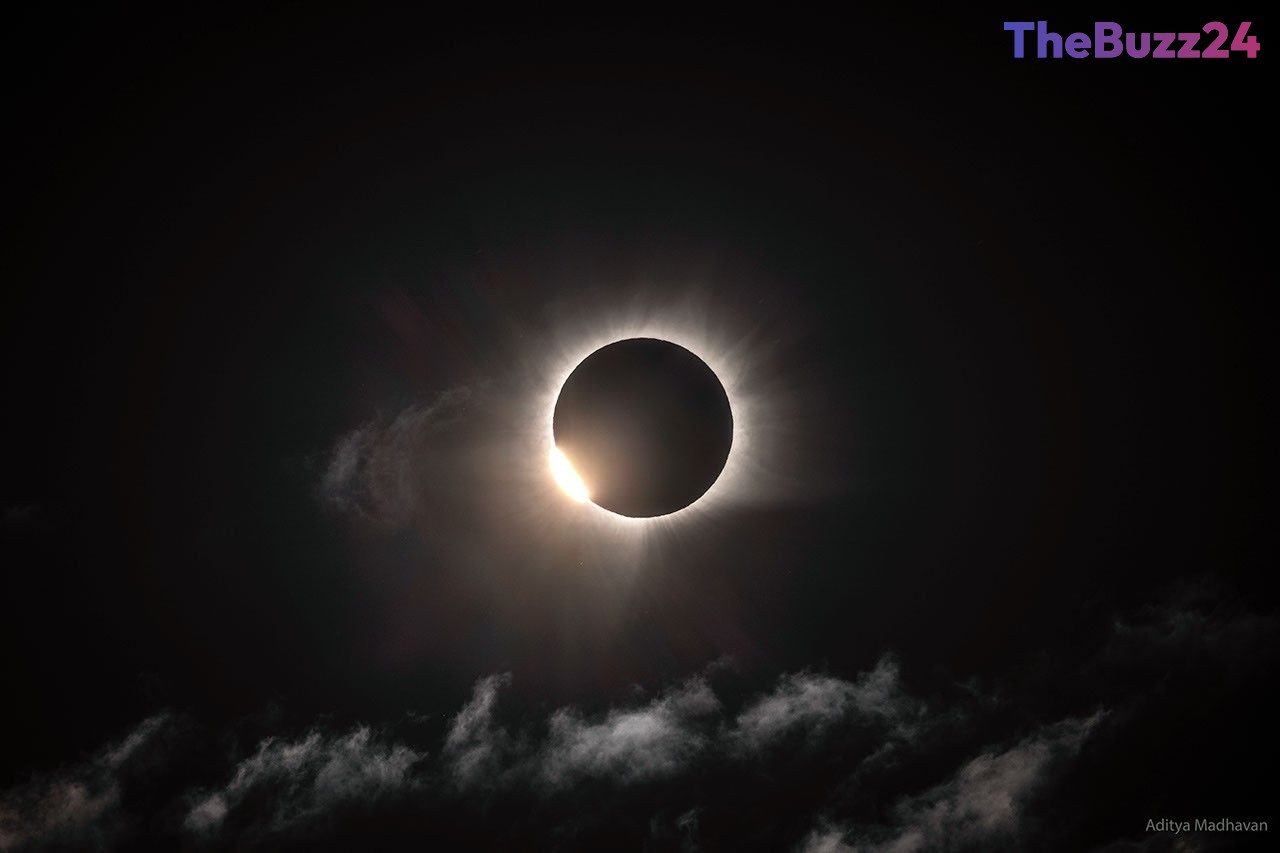
Celestial Spectacle: 2026 Total Solar Eclipse Unveils Diamond Ring Over Greenland
On August 12, 2026, a spectacular total solar eclipse captivated observers across a narrow band of Earth, stretching from the remote Arctic Ocean to parts of Europe. The Moon’s shadow, known as the umbra, embarked on its journey across our planet, first touching down in the vast expanse of the Arctic before sweeping over Greenland, Iceland, and the Atlantic Ocean, eventually reaching the Iberian Peninsula, including Portugal and northern Spain. This rare celestial alignment offered a breathtaking display for those fortunate enough to be positioned within its path of totality.
Among the first to witness the full grandeur of the eclipsed Sun was astrophotographer Aditya Madhavan, who successfully captured a stunning image from Rype Fjord on Greenland’s east coast. Despite the challenging weather conditions often prevalent in the region, Madhavan’s perseverance paid off, yielding what is believed to be one of the initial unobstructed views of the total eclipse. The photograph, taken at 17:33:26 UTC, dramatically showcases the fleeting “diamond ring” effect—a brilliant bead of sunlight shining through a lunar valley—just as totality began, alongside the ethereal glow of the Sun’s magnificent corona.
Total solar eclipses are profound astronomical events, offering a unique opportunity to observe the Sun’s outer atmosphere, the corona, which is typically obscured by the Sun’s intense brightness. The “diamond ring” phenomenon, a hallmark of these eclipses, marks the precise moments when the last sliver of sunlight disappears or the first ray reappears. Such events not only provide awe-inspiring visual experiences but also offer invaluable data for scientists studying the Sun’s dynamics and its influence on Earth. The 2026 eclipse served as a powerful reminder of the universe’s ongoing celestial ballet.
Key Takeaways
- A total solar eclipse occurred on August 12, 2026, with its path of totality crossing the Arctic, Greenland, Iceland, and parts of Europe.
- Astrophotographer Aditya Madhavan captured a rare, unobstructed view from Greenland, showcasing the 'diamond ring' effect and the Sun's corona.
- The event provided a spectacular celestial display for observers in its narrow path, highlighting the beauty and scientific value of solar eclipses.
Editor’s Analysis & Impact
The 2026 total solar eclipse, particularly the stunning capture from Greenland, underscores the enduring public and scientific fascination with astronomical phenomena. While direct economic impact is minimal, such events significantly boost astrotourism and public engagement in science, potentially influencing funding for solar research and space exploration initiatives. The event also highlights advancements in astrophotography, allowing for increasingly detailed documentation of celestial occurrences. Looking ahead, these eclipses continue to serve as powerful educational tools, inspiring future generations of scientists and fostering a global appreciation for the cosmos. They reinforce the importance of international collaboration in scientific observation and the continuous quest to understand our universe.
Frequently Asked Questions
Q: What is a total solar eclipse?
A: A total solar eclipse occurs when the Moon passes directly between the Sun and Earth, completely blocking the Sun's face and casting a shadow on Earth. This allows observers in the path of totality to see the Sun's corona.
Q: What is the 'diamond ring' effect during an eclipse?
A: The 'diamond ring' effect is a phenomenon seen just before or after totality during a solar eclipse. It occurs when a single bead of sunlight shines through a valley on the Moon's limb, creating a brilliant 'diamond' on the 'ring' of the Sun's corona.
Q: Where was the 2026 total solar eclipse visible?
A: The path of totality for the August 12, 2026, total solar eclipse stretched from the Arctic Ocean, across Greenland, Iceland, the Atlantic Ocean, and concluded over Portugal and northern Spain.
AI Disclosure: This article is based on verified data and official reports. Our Team and AI have cross-referenced every financial detail with primary sources to ensure total accuracy.
More from this Category