Galactic Spectacle: Milky Way Arches Over Yellowstone’s Silex Spring
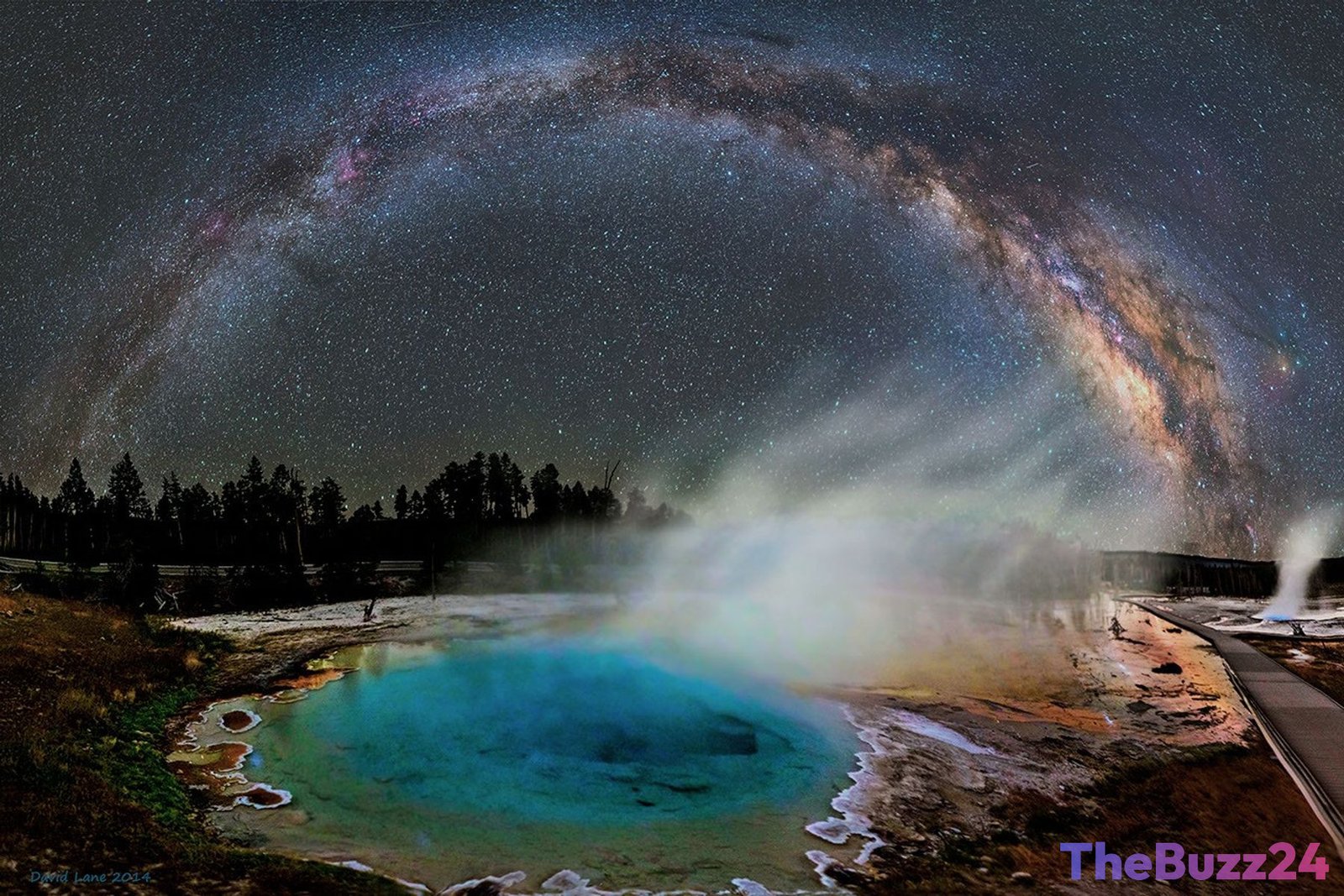
A breathtaking panorama captures the majestic sweep of the Milky Way galaxy arching over the vibrant Silex Spring in Yellowstone National Park. The image, a composite of 16 photographs taken in 2014, showcases the stark contrast between the earthly geothermal wonder and the celestial grandeur above.
Silex Spring, a colorful pool approximately 10 meters in diameter, owes its vivid hues to thermophilic bacteria thriving in its hot waters. These bacteria form distinct layers, creating a mesmerizing visual display. The steam rising from the spring is a testament to the intense geothermal activity beneath the surface, fueled by the Yellowstone Hotspot, a geological phenomenon linked to past supervolcanic events.
Far above this dynamic landscape, the central band of our own Milky Way Galaxy is brilliantly illuminated by billions of stars. The photograph serves as a reminder of both the powerful geological forces shaping our planet and the vast, awe-inspiring universe that surrounds us. The Yellowstone Hotspot’s history includes a supervolcanic eruption approximately 640,000 years ago, an event with significant implications for a large portion of North America.
Key Takeaways
- The Milky Way galaxy is visible above Silex Spring in Yellowstone National Park.
- Silex Spring's colors are due to heat-loving bacteria, and steam indicates geothermal activity from the Yellowstone Hotspot.
- The Yellowstone Hotspot has a history of supervolcanic eruptions, posing potential future risks.
Editor’s Analysis & Impact
This stunning image highlights the intersection of geological and astronomical phenomena. The vibrant colors of Silex Spring, a product of extremophile bacteria, stand in beautiful contrast to the distant starlight of the Milky Way. It serves as a potent reminder of Earth’s dynamic internal processes, particularly the Yellowstone Hotspot, which has a history of dramatic volcanic activity. The juxtaposition encourages reflection on our planet’s place within the vastness of the cosmos and the ongoing geological forces that continue to shape our world.
Frequently Asked Questions
Q: What causes the colors in Silex Spring?
A: The vibrant colors in Silex Spring are caused by different species of thermophilic bacteria, which are microorganisms that thrive in hot environments. These bacteria form distinct layers, each contributing to the overall color palette of the pool.
Q: What is the Yellowstone Hotspot?
A: The Yellowstone Hotspot is a mantle plume, a region where unusually hot rock from deep within the Earth's mantle rises to the surface. This hotspot is responsible for the intense geothermal activity in Yellowstone National Park, including geysers and hot springs, and has caused massive volcanic eruptions in the past.
Q: Is there a risk of another supervolcanic eruption at Yellowstone?
A: Scientists monitor the Yellowstone caldera closely. While the hotspot remains active and has caused past supervolcanic eruptions, the probability of another such event in the near future is considered very low. However, the potential impact of such an eruption would be significant.
AI Disclosure: This article is based on verified data and official reports. Our Team and AI have cross-referenced every financial detail with primary sources to ensure total accuracy.
More from this Category