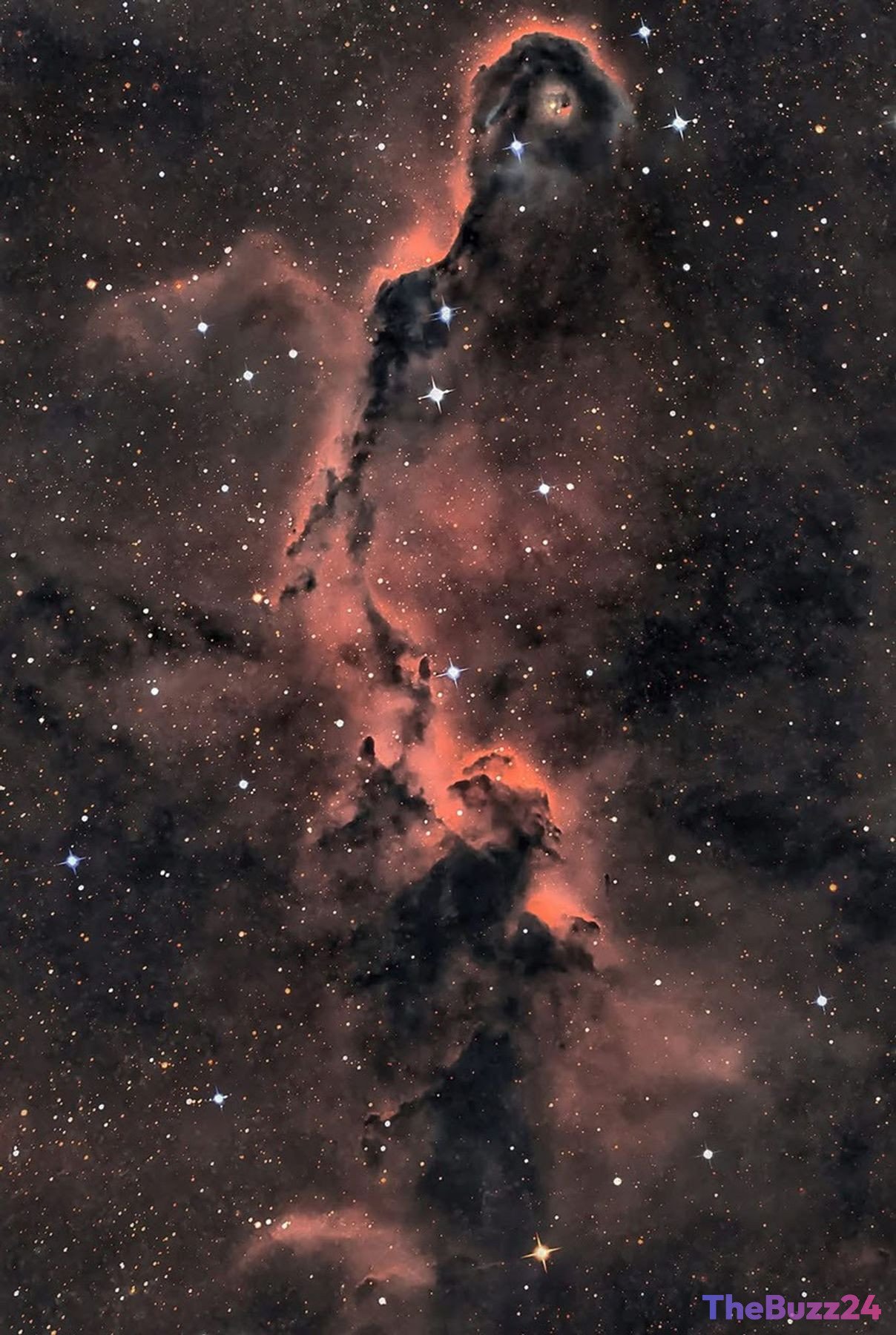
Cosmic Nursery Unveiled: The Majestic Elephant’s Trunk Nebula in Cepheus
The vast expanse of the constellation Cepheus hosts a celestial wonder known as the Elephant’s Trunk Nebula, an intricate structure winding through the emission region and young star cluster complex IC 1396. This cosmic formation, also cataloged as vdB 142, presents a striking visual reminiscent of its namesake, stretching an impressive length of over 20 light-years across the interstellar medium.
Detailed telescopic observations reveal a dynamic environment within the nebula. It is characterized by luminous, swept-back ridges of gas and pockets of cool interstellar dust. Crucially, the darker, tendril-shaped clouds within this region are not merely shadows but are the very raw material from which new stars are born, concealing protostars in their dense cores. These stellar nurseries are vital for understanding the lifecycle of stars and galaxies.
Located nearly 3,000 light-years from Earth, the IC 1396 complex is a sprawling entity, covering a significant portion of the night sky, spanning more than 5 degrees. While the entire complex is vast, the distinctive proboscidean-like shape of the Elephant’s Trunk Nebula itself extends across an almost 1-degree wide field of view, an angular size slightly less than that of two full moons. This makes it a prominent, albeit relatively faint, target for astronomical study.
Key Takeaways
- The Elephant's Trunk Nebula (vdB 142) is a prominent star-forming region located in the constellation Cepheus, part of the larger IC 1396 complex.
- This nebula is over 20 light-years long and contains dense, dark tendrils of gas and dust that are actively concealing and forming new protostars.
- Situated nearly 3,000 light-years away, the complex covers a significant angular area in the sky, making it a key subject for studying stellar evolution.
Editor’s Analysis & Impact
The study and observation of nebulae like the Elephant’s Trunk are fundamental to astrophysics, offering invaluable insights into the processes of star formation and galactic evolution. Discoveries within these cosmic nurseries help refine our models of how stars, including our own Sun, are born and how planetary systems might emerge. The detailed imaging of such regions, often facilitated by advanced telescopes, contributes to a broader understanding of the universe’s composition and dynamics. Future advancements in observational technology, such as next-generation space telescopes, promise even higher resolution views, potentially revealing more about the earliest stages of stellar development and the complex interplay of gas, dust, and gravity that shapes these magnificent structures. This ongoing research underpins our knowledge of the cosmos and our place within it.
Frequently Asked Questions
Q: What is the Elephant's Trunk Nebula?
A: The Elephant's Trunk Nebula, also known as vdB 142, is a prominent interstellar cloud of gas and dust located within the larger IC 1396 emission region in the constellation Cepheus. It is a well-known stellar nursery where new stars are actively forming.
Q: How large is the Elephant's Trunk Nebula?
A: The Elephant's Trunk Nebula itself stretches over 20 light-years in length. The broader IC 1396 complex, of which it is a part, spans more than 5 degrees across the sky, while the distinctive "trunk" portion covers almost 1 degree.
Q: Why is the Elephant's Trunk Nebula important to astronomers?
A: Astronomers study the Elephant's Trunk Nebula because its dense, dark tendrils contain the raw materials for star formation and hide protostars. It serves as an excellent natural laboratory for understanding the conditions and processes under which stars are born, providing crucial data for theories of stellar evolution.
AI Disclosure: This article is based on verified data and official reports. Our Team and AI have cross-referenced every financial detail with primary sources to ensure total accuracy.
More from this Category