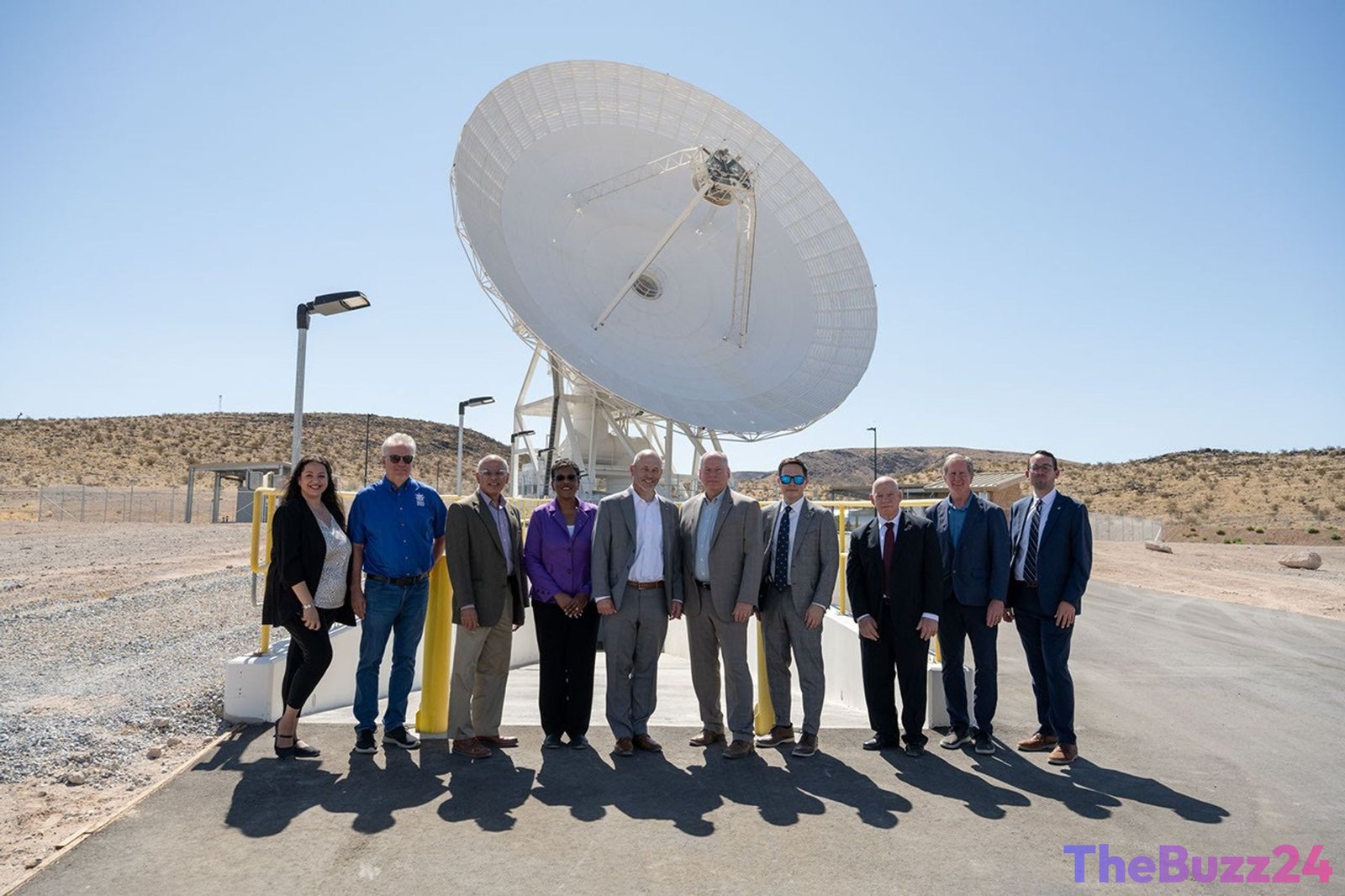
NASA Expands Cosmic Communications with New Deep Space Station 23 Antenna in California
NASA has officially expanded its capabilities to communicate with distant spacecraft following a ribbon-cutting ceremony for the newly completed Deep Space Station 23 (DSS-23) antenna. Located at the Goldstone Deep Space Communications Complex near Barstow, California, the event on August 25, 2026, marked a major milestone for the Deep Space Network (DSN). Leadership from NASA Headquarters, the Jet Propulsion Laboratory (JPL), and the DSN gathered to celebrate the completion of this state-of-the-art facility.
The DSS-23 antenna is the latest addition to the DSN’s ambitious Aperture Enhancement Project, an initiative launched in 2009 to modernize and expand global space communications. The project focuses on deploying six new 34-meter (114-foot) multifrequency beam-waveguide antennas. These highly versatile dishes are designed to support a wide array of space exploration missions, operating across multiple radio frequencies to transmit commands and receive critical scientific data from deep space.
The Deep Space Network serves as the essential lifeline for interplanetary missions, enabling scientists on Earth to track and control spacecraft traveling millions of miles away. The network is managed by JPL, a division of Caltech, on behalf of NASA’s Space Communications and Navigation (SCan) program. With the integration of DSS-23, the network’s capacity to handle the growing volume of data from upcoming lunar and deep-space missions is significantly bolstered.
Key Takeaways
- NASA has officially inaugurated the Deep Space Station 23 (DSS-23) antenna at the Goldstone complex in California.
- The 34-meter antenna is part of the Aperture Enhancement Project, which has been expanding the Deep Space Network's capabilities since 2009.
- The new multifrequency beam-waveguide antenna will enhance communication, tracking, and data collection for numerous deep-space missions.
Editor’s Analysis & Impact
The completion of Deep Space Station 23 represents a critical infrastructure upgrade for the global aerospace sector. As humanity enters a new era of deep-space exploration—marked by the Artemis lunar missions and planned crewed voyages to Mars—the demand for high-bandwidth, reliable communication is skyrocketing. The Deep Space Network has historically faced bandwidth bottlenecks due to the sheer volume of active missions. By adding versatile, multifrequency 34-meter antennas like DSS-23, NASA is directly addressing these constraints. This expansion not only ensures the success of upcoming government-led scientific endeavors but also paves the way for commercial space ventures that will rely on robust communication networks. Ultimately, investing in ground-based infrastructure is just as vital as building the spacecraft themselves, securing the foundation for the next century of cosmic discovery.
Frequently Asked Questions
Q: What is the purpose of NASA's Deep Space Network (DSN)?
A: The Deep Space Network is a global network of giant radio antennas that supports interplanetary spacecraft missions, allowing scientists to track vehicles, send commands, and receive scientific data from deep space.
Q: Where is the new DSS-23 antenna located?
A: The DSS-23 antenna is located at the Goldstone Deep Space Communications Complex near Barstow, California.
Q: What is the Aperture Enhancement Project?
A: Initiated in 2009, it is a long-term project to upgrade and expand the Deep Space Network by adding six new 34-meter (114-foot) multifrequency beam-waveguide antennas to improve communication capabilities.
AI Disclosure: This article is based on verified data and official reports. Our Team and AI have cross-referenced every financial detail with primary sources to ensure total accuracy.
More from this Category