Cosmic Halloween: Unveiling the ‘Demon Star’ and the ‘Witch Head Nebula’
As autumn nights lengthen, stargazers have a unique opportunity to explore celestial wonders with a spooky theme. Among the most captivating is the star system Algol, often referred to as ‘The Demon Star’ or ‘The Ghoul.’ Located in the constellation Perseus, Algol becomes visible in the northeastern sky after 9 PM during the fall months, alongside Cassiopeia and Andromeda. In ancient Greek mythology, Algol’s variability in brightness was likened to the ‘blinking eye’ of the gorgon Medusa.
This celestial ‘blink’ is not a myth but a scientific phenomenon. Algol is actually a triple-star system, with two of its stars locked in a close orbit. This configuration creates an eclipsing binary, causing the system’s apparent brightness to fluctuate from a magnitude of +2.1 to a dimmer +3.4 approximately every three days. Data captured by NASA’s Transiting Exoplanet Survey Satellite (TESS) visually confirms this regular dimming, mirroring the legendary blinking eye.
For those looking to observe Algol, Perseus can be located using the constellations Cassiopeia and Andromeda as guides. The star Almach in Andromeda serves as a helpful marker for pinpointing Algol. While various resources exist to help calculate Algol’s dimming periods, comparing its brightness to the nearby star Almach using binoculars or a small telescope can offer a direct visual confirmation of its variability.
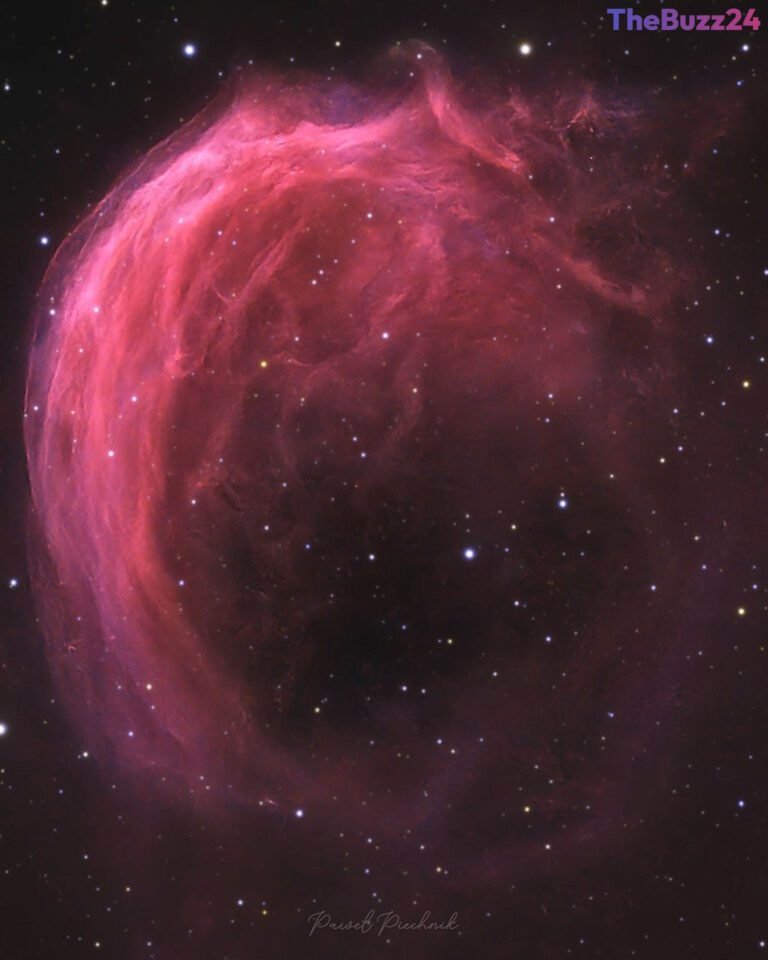
Adding to the season’s eerie ambiance is the Witch Head Nebula (IC 2118), a reflection nebula situated between the constellations Eridanus and Orion. Illuminated by the bright star Rigel, this nebula is approximately 900 light-years from Earth. Reflection nebulae depend on the light of nearby stars for visibility, making distant ones like the Witch Head Nebula challenging to observe with the naked eye. However, telescopes with large apertures and low magnification can reveal its haunting silhouette under dark skies. Astrophotographers can also capture this spectral form, with the time required depending on equipment and atmospheric conditions.
Key Takeaways
- The star Algol, known as 'The Demon Star,' exhibits a noticeable dimming every three days due to its eclipsing binary nature, likened to the 'blinking eye' of Medusa.
- The Witch Head Nebula, a reflection nebula located between Eridanus and Orion, is visible through telescopes and is a popular subject for astrophotography.
- Both Algol and the Witch Head Nebula are observable in the autumn night sky, offering unique 'spooky' celestial sights for stargazers.
Editor’s Analysis & Impact
The celestial phenomena described, such as Algol’s variability and the visual characteristics of the Witch Head Nebula, highlight the ongoing fascination with astronomy and its connection to cultural narratives. These discoveries, often facilitated by advanced space missions like TESS, underscore the importance of continued investment in space exploration and scientific observation. For the public, these ‘spooky’ celestial objects offer an accessible entry point into understanding complex astronomical concepts, potentially fostering greater interest in STEM fields. The ability to observe these distant wonders also speaks to the advancements in telescope technology and astrophotography, making the universe more accessible than ever before.
Frequently Asked Questions
Q: How can I find the star Algol?
A: Algol is located in the constellation Perseus. You can find it in the northeastern sky during autumn evenings, often using the constellations Cassiopeia and Andromeda as guides. The star Almach in Andromeda can also serve as a helpful marker to locate Algol.
Q: Why is Algol called 'The Demon Star'?
A: Algol is nicknamed 'The Demon Star' or 'The Ghoul' because its brightness varies noticeably over a cycle of approximately three days. This fluctuation is caused by two stars in the system orbiting each other, with one periodically passing in front of the other, dimming the overall light. This variability was historically associated with the 'blinking eye' of the mythical gorgon Medusa.
Q: Is the Witch Head Nebula visible to the naked eye?
A: The Witch Head Nebula is a reflection nebula located about 900 light-years away. Due to its distance and reliance on reflected starlight, it is generally not visible to the naked eye. However, it can be observed with telescopes, particularly those with large apertures and low magnification, under dark sky conditions. It is also a popular target for astrophotography.
AI Disclosure: This article is based on verified data and official reports. Our Team and AI have cross-referenced every financial detail with primary sources to ensure total accuracy.
More from this Category