Cosmic Revelation: Webb Telescope Unveils Strongest Evidence for ‘Black Hole Stars’
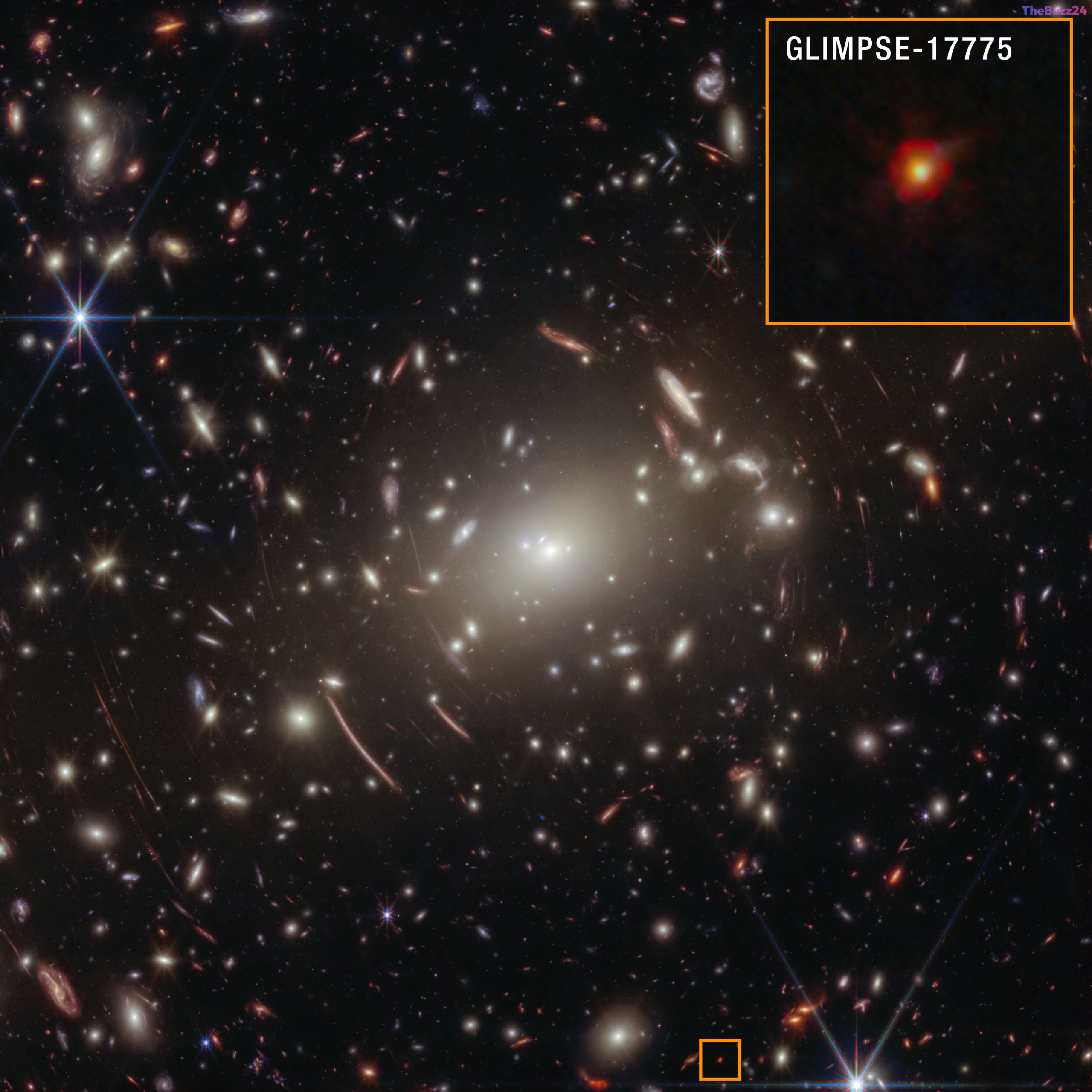
The James Webb Space Telescope has delivered its most compelling evidence yet for the existence of “black hole stars,” a theoretical class of objects believed to be rapidly growing supermassive black holes shrouded in dense gas. This significant finding emerged from observations of the galaxy cluster Abell S1063, where scientists unexpectedly obtained an exceptionally detailed spectrum of a distant “little red dot” designated GLIMPSE-17775. These mysterious red objects, first identified by Webb in 2022, have puzzled astronomers due to their abundance in the very early universe, appearing approximately 600 million years after the Big Bang.
A team of astronomers, spearheaded by Vasily Kokorev at the University of Texas at Austin, meticulously analyzed the unprecedented data from GLIMPSE-17775. While the primary objective of the Webb observations was to search for Population III stars and faint galaxies, the fortuitous inclusion of GLIMPSE-17775 in the spectroscopic survey proved invaluable. Situated far behind the galaxy cluster, the light from GLIMPSE-17775 was magnified by gravitational lensing, effectively transforming Webb’s 30 hours of observation into the equivalent of 80 hours of telescope time. This natural amplification, combined with Webb’s infrared sensitivity, yielded over 40 distinct spectral lines, making it the most detailed spectrum ever recorded for a “little red dot.”
The extensive spectroscopic data provided multiple independent lines of evidence supporting the “black hole star” (BH*) model. Analysis revealed a broadening effect known as electron scattering in spectral lines of hydrogen, oxygen, and helium, indicative of a dense, layered gas cocoon enveloping the source. Furthermore, the intensity and ratios of specific lines, including a remarkable “iron forest” of 16 iron lines and certain oxygen lines, necessitate a high-energy source like a rapidly accreting black hole. The presence of both fluorescence and absorption of helium further points to a powerful central engine surrounded by a dense medium. This BH* scenario also elegantly explains why most “little red dots” appear faint in X-rays, as the dense gas cocoon would absorb such emissions.
Integrating ancillary data from the Hubble Space Telescope’s Frontier Fields and BUFFALO programs, the team also addressed the weaker-than-expected Balmer break in GLIMPSE-17775’s spectrum. This revealed a giant host galaxy surrounding the object, a finding consistent with the dense gas cocoon model, where excess blue light is attributed to stars within the host galaxy. This comprehensive understanding suggests that the discovery fits well within existing cosmological frameworks, alleviating previous concerns that these early, luminous objects might “break cosmology” by requiring impossibly large black hole masses. The findings offer crucial insights into the rapid growth of black holes and galaxy evolution in the nascent universe, paving the way for further exploration into the enigmatic power sources of these cosmic beacons.
Key Takeaways
- JWST observations of GLIMPSE-17775 provide the most compelling evidence to date for the "black hole star" model.
- The "black hole star" model describes a rapidly growing supermassive black hole encased in a dense, partially ionized gas cocoon.
- Detailed spectral analysis, including over 40 spectral lines and combined data from Hubble, supports this interpretation and helps resolve previous cosmological puzzles.
Editor’s Analysis & Impact
This discovery by the James Webb Space Telescope marks a significant advancement in astrophysics, particularly in understanding the early universe and the formation of supermassive black holes. The confirmation of the “black hole star” model for objects like GLIMPSE-17775 provides a robust framework for explaining the rapid growth of black holes shortly after the Big Bang, which has long been a theoretical challenge. This research strengthens the foundation of current cosmological models, suggesting that the universe’s evolution is consistent with observed phenomena. Future implications include guiding targeted observations for similar objects, refining models of galaxy co-evolution with their central black holes, and potentially uncovering new insights into the mechanisms driving cosmic structure formation. It underscores the critical role of advanced observatories like Webb in pushing the boundaries of human knowledge.
Frequently Asked Questions
Q: What are "little red dots"?
A: "Little red dots" are a mysterious class of abundant, luminous objects discovered by the James Webb Space Telescope in the very early universe, appearing approximately 600 million years after the Big Bang. Their exact nature has been a subject of intense astronomical study.
Q: What is the "black hole star" (BH*) scenario?
A: The "black hole star" (BH*) scenario proposes that these "little red dots" are not conventional stars or galaxies, but rather rapidly growing supermassive black holes that are deeply embedded within a dense cocoon of partially ionized gas. This cocoon reprocesses the light emitted from near the black hole, producing the unique spectral features observed.
Q: How did gravitational lensing aid this discovery?
A: Gravitational lensing, a phenomenon where massive objects like galaxy clusters bend and magnify light from more distant sources, significantly enhanced the Webb Telescope's observations of GLIMPSE-17775. It effectively amplified the light, allowing for a much deeper and more detailed spectrum to be obtained than would otherwise be possible, providing crucial data for analysis.
AI Disclosure: This article is based on verified data and official reports. Our Team and AI have cross-referenced every financial detail with primary sources to ensure total accuracy.
More from this Category