Cosmic Wonders of Cygnus: Navigating Starlit Jewels, Supernova Remnants, and the First Known Black Hole
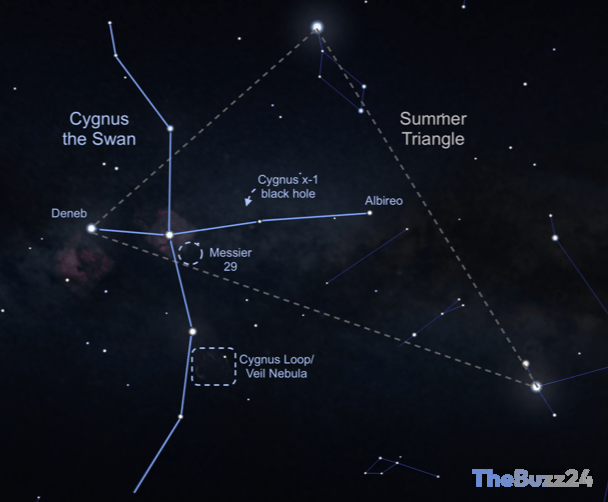
As the summer skies unfurl across the northern hemisphere, the constellation Cygnus, often referred to as the Celestial Swan or the Northern Cross, serves as an expansive laboratory for both amateur stargazers and professional astrophysicists. Anchored by the brilliant supergiant Deneb—one of the three vertices of the famous Summer Triangle—Cygnus traces a breathtaking path directly along the luminous band of the Milky Way. For observers under dark skies, modest binoculars reveal dense cosmic features, including the open cluster Messier 29, a vibrant nursery of young stars set against glowing interstellar gas.
Deeper astronomical exploration reveals intricate stellar phenomena scattered throughout the constellation’s celestial borders. Among its most striking targets is Albireo, a famed optical double star situated at the head of the swan. Viewed through a backyard telescope, Albireo splits into a visually stunning pair featuring a bright golden star beside a vivid sapphire companion. Nearby, the ethereal Cygnus Loop—also known as the Veil Nebula—stretches roughly three degrees across the sky. This massive, delicate filamentary ring represents the expanding gaseous debris of an ancient supernova blast, measuring nearly six times the apparent width of the full Moon.
Beyond visible wonders, Cygnus harbors one of the most critical landmarks in modern high-energy astrophysics: Cygnus X-1. First detected via suborbital rocket instruments in 1971 and extensively scrutinized by advanced space observatories such as the Chandra X-ray Observatory, Cygnus X-1 holds historical significance as the first X-ray source widely confirmed to be a black hole. Possessing an estimated mass roughly 20 times that of the Sun, the stellar-mass black hole is locked in a gravitational dance with a massive blue companion star, violently stripping material from it while rotating at an astonishing rate exceeding 800 times per second.
Located approximately 6,070 light-years from Earth, Cygnus X-1 poses no danger to our solar system, yet it continues to offer researchers vital insight into the mechanics of stellar collapse, extreme gravity, and accretion dynamics. Whether viewed through simple binoculars or studied with high-energy space telescopes, the constellation Cygnus remains an exceptional gateway to understanding the full lifecycle of stars in our galaxy.
Key Takeaways
- Cygnus contains diverse observational targets ranging from the vibrant binary star Albireo to the expansive Veil Nebula supernova remnant.
- Cygnus X-1, located roughly 6,070 light-years away, was the first X-ray source universally accepted by astronomers as a stellar-mass black hole.
- Rotating over 800 times per second with a mass equal to roughly 20 Suns, Cygnus X-1 continues to provide valuable data on accretion physics and gravitational extremes.
Editor’s Analysis & Impact
The constellation Cygnus illustrates the essential bridge between accessible amateur astronomy and cutting-edge astrophysics. While visual gems like Albireo and the Cygnus Loop inspire public engagement and celestial photography, high-energy targets like Cygnus X-1 remain fundamental to testing theoretical physics. As next-generation observatories—such as NASA’s Roman Space Telescope and future X-ray missions—come online, rich galactic sectors like Cygnus will serve as primary reference fields for refining our understanding of stellar evolution, black hole accretion discs, and galactic chemical enrichment. The ongoing study of these objects reinforces how multi-wavelength astronomy transforms our perception of seemingly static night-sky constellations into dynamic cosmic laboratories.
Frequently Asked Questions
Q: What makes Cygnus X-1 scientifically significant?
A: Discovered in 1971, Cygnus X-1 was the first X-ray source widely confirmed to be a black hole. It provides scientists with an ideal natural laboratory to study intense gravitational fields, accretion disc physics, and relativistic particle jets.
Q: What equipment is needed to view the features of Cygnus?
A: Basic binoculars are sufficient to view the open cluster Messier 29 and rich star fields along the Milky Way. A small amateur telescope is recommended to clearly resolve the gold-and-blue binary star Albireo and the intricate filaments of the Veil Nebula.
Q: What is the Cygnus Loop?
A: The Cygnus Loop, also referred to as the Veil Nebula, is an expanding supernova remnant composed of hot, glowing gases released when a massive star exploded thousands of years ago.
AI Disclosure: This article is based on verified data and official reports. Our Team and AI have cross-referenced every financial detail with primary sources to ensure total accuracy.
More from this Category