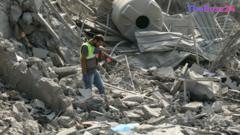
Deadly Israeli Strikes Escalate Tensions in Southern Lebanon Amidst Fragile Ceasefire
Southern Lebanon has been rocked by a series of Israeli strikes that claimed the lives of eleven people, marking one of the deadliest days of attacks since a June agreement aimed at de-escalating hostilities. The casualties include women and children, raising significant concerns about the ongoing conflict.
Lebanese authorities reported that seven individuals were killed in a strike on a house on the outskirts of Ansar in the Nabatieh district. State media indicated that among the deceased were three children and two women. Later the same day, another round of strikes hit the town of Deir al-Zahrani, resulting in four more fatalities and five injuries, according to the Lebanese Ministry of Health. The Israel Defense Forces (IDF) stated that these strikes targeted “Hezbollah terror infrastructure” and were a response to an earlier action against its soldiers, specifically mentioning an incident in the strategic Ali al-Taher Ridge.
Lebanon’s Prime Minister Nawaf Salam condemned the attacks, emphasizing that the civilians killed were not military targets and called for an immediate halt to the escalation. President Joseph Aoun echoed this sentiment, denouncing the strikes as “repeated violations” of the June framework and a clear message to the US-led negotiations. The June ceasefire framework was designed to reduce hostilities, calling for Hezbollah’s disarmament, a gradual Israeli withdrawal from southern Lebanon, and the deployment of the Lebanese army in the area. However, Hezbollah was not a party to this agreement and has rejected direct negotiations.
Despite the framework, Israeli strikes and demolitions have persisted in southern Lebanon. Hezbollah leader Naim Qassem recently criticized Lebanese authorities for their handling of the agreement, accusing them of pressuring the Lebanese army while Israeli attacks continued. As tensions remain high, Lebanese and Israeli negotiators are slated to meet for an eighth round of talks in September, though a definitive date has yet to be established, underscoring the precarious state of peace in the region.
Key Takeaways
- Recent Israeli strikes in southern Lebanon resulted in 11 deaths, including women and children, marking a significant escalation since a June agreement.
- Israel's military stated the strikes targeted "Hezbollah terror infrastructure" in response to actions against its soldiers, while Lebanese officials condemned the attacks as violations of the ceasefire.
- The incidents highlight the fragility of the June ceasefire framework, which aimed to reduce hostilities, and underscore ongoing tensions despite diplomatic efforts.
Editor’s Analysis & Impact
The recent deadly Israeli strikes in southern Lebanon signal a dangerous escalation in a region already fraught with instability, severely testing the fragile June ceasefire framework. While the immediate market impact is likely localized, a sustained increase in hostilities could disrupt regional trade and energy flows, potentially affecting global markets. The future outlook remains highly volatile, with the ceasefire agreement appearing increasingly tenuous. Diplomatic efforts, particularly the US-led negotiations, face immense challenges as long as key actors like Hezbollah remain outside the agreement and continue to operate independently. The broader implications include a significant undermining of international de-escalation efforts, heightened humanitarian concerns due to civilian casualties, and a complex geopolitical ripple effect involving Israel, Lebanon, Hezbollah, Iran, and the United States.
Frequently Asked Questions
Q: What prompted the recent Israeli strikes in southern Lebanon?
A: The Israeli military stated its strikes targeted "Hezbollah terror infrastructure" in response to an earlier action against its soldiers, specifically mentioning an incident in the Ali al-Taher Ridge.
Q: What is the June ceasefire framework mentioned in the article?
A: The June ceasefire framework is an agreement aimed at reducing hostilities between Israel and Lebanon. It calls for Hezbollah to disarm, Israeli forces to gradually withdraw from southern Lebanon, and the Lebanese army to deploy across the area.
Q: Why are these strikes significant despite the ceasefire agreement?
A: These strikes are significant because they resulted in a high number of civilian casualties, including children and women, making it one of the deadliest days since the June agreement was announced. They highlight the ongoing fragility of the ceasefire and the persistent tensions in the region.
AI Disclosure: This article is based on verified data and official reports. Our Team and AI have cross-referenced every financial detail with primary sources to ensure total accuracy.
More from this Category