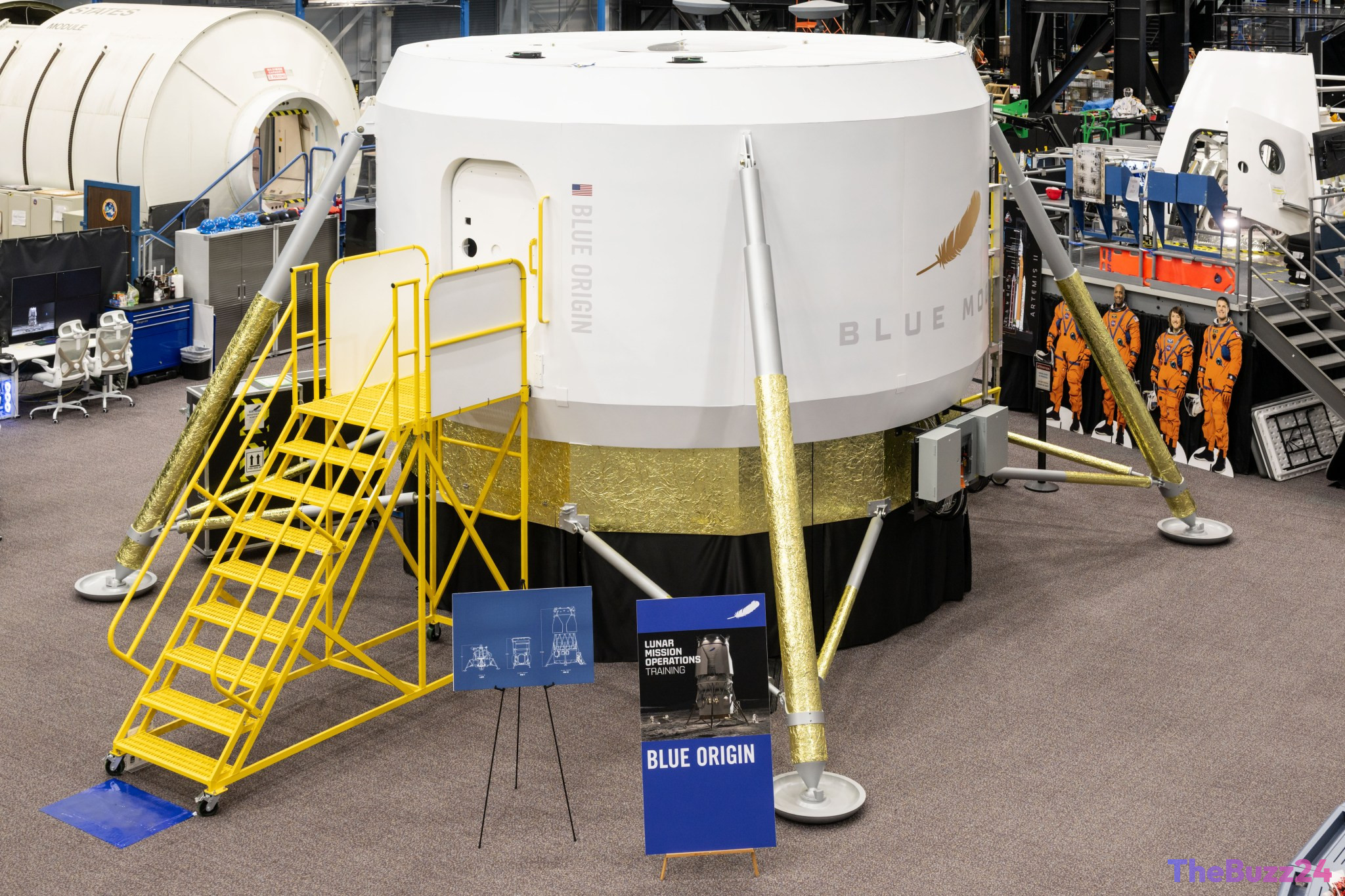
Blue Origin Delivers Lunar Lander Prototype to NASA for Artemis Training
A significant milestone in lunar exploration has been reached with the arrival of a full-scale prototype of Blue Origin’s Blue Moon Mark 2 crew lander cabin at NASA’s Johnson Space Center. Standing over 15 feet tall, the mock-up is now fully operational, serving as a critical training ground for astronauts preparing for the upcoming Artemis missions. This facility allows crews to familiarize themselves with the environment they will inhabit during future lunar surface operations.
The cabin is a vital component of the broader Blue Moon lander system, which is being developed to transport astronauts from lunar orbit to the Moon’s surface. The final operational lander, which will stand approximately 52 feet tall, is designed to launch on Blue Origin’s New Glenn rocket. Once in space, it will rendezvous with NASA’s Orion spacecraft, providing a dedicated space for astronauts to live, conduct scientific research, and manage mission-critical tasks while on the lunar surface.
At the Johnson Space Center, the prototype is currently being used for ‘human-in-the-loop’ testing. Astronauts are practicing essential mission scenarios, including lunar egress via the exterior ladder, communications protocols with mission control, and spacesuit integration. As the program advances, the mock-up will be upgraded into a fully integrated simulator, allowing for collaborative rehearsals between flight crews and ground teams. This iterative testing process is essential for refining the lander’s design and ensuring mission safety.
These preparations are part of the broader Artemis initiative, which aims to return humans to the Moon by 2028. Following the success of Artemis II, upcoming missions will focus on testing complex rendezvous and docking procedures with commercial landers in Earth orbit. These efforts are not only focused on lunar exploration but are also intended to establish the technological foundation for future human missions to Mars.
Key Takeaways
- Blue Origin has delivered a full-scale prototype of its Blue Moon Mark 2 crew cabin to NASA for astronaut training.
- The mock-up allows for critical 'human-in-the-loop' testing, including egress procedures, communications, and mission simulations.
- The lander is a key component of the Artemis program, which aims to return humans to the lunar surface by 2028 and eventually support Mars exploration.
Editor’s Analysis & Impact
The delivery of the Blue Moon Mark 2 prototype underscores the increasing reliance of government space agencies on commercial partnerships to achieve ambitious exploration goals. By integrating private sector hardware into NASA’s training pipeline, the Artemis program is accelerating its development timeline while fostering a competitive aerospace ecosystem. The shift toward ‘human-in-the-loop’ testing with commercial hardware represents a maturation of the space industry, where iterative design and ground-based simulation are becoming the standard for risk mitigation. Looking ahead, the success of these docking and life-support tests will be the primary indicator of whether the 2028 lunar landing target is feasible. Furthermore, the modular nature of these landers suggests that the technology developed today will likely serve as the backbone for long-term lunar infrastructure and the eventual transition to deep-space exploration, including crewed missions to Mars.
Frequently Asked Questions
Q: What is the purpose of the Blue Moon Mark 2 cabin prototype at NASA?
A: The prototype is used to train astronauts for lunar surface operations, allowing them to practice mission scenarios, egress, communications, and scientific experiments in a realistic environment.
Q: When does NASA plan to return humans to the Moon?
A: NASA is currently working toward returning humans to the lunar surface by 2028 as part of the Artemis program.
AI Disclosure: This article is based on verified data and official reports. Our Team and AI have cross-referenced every financial detail with primary sources to ensure total accuracy.
More from this Category