NASA’s Curiosity Rover Marks 5,000 Days on Mars with Striking Dual-Time Postcard
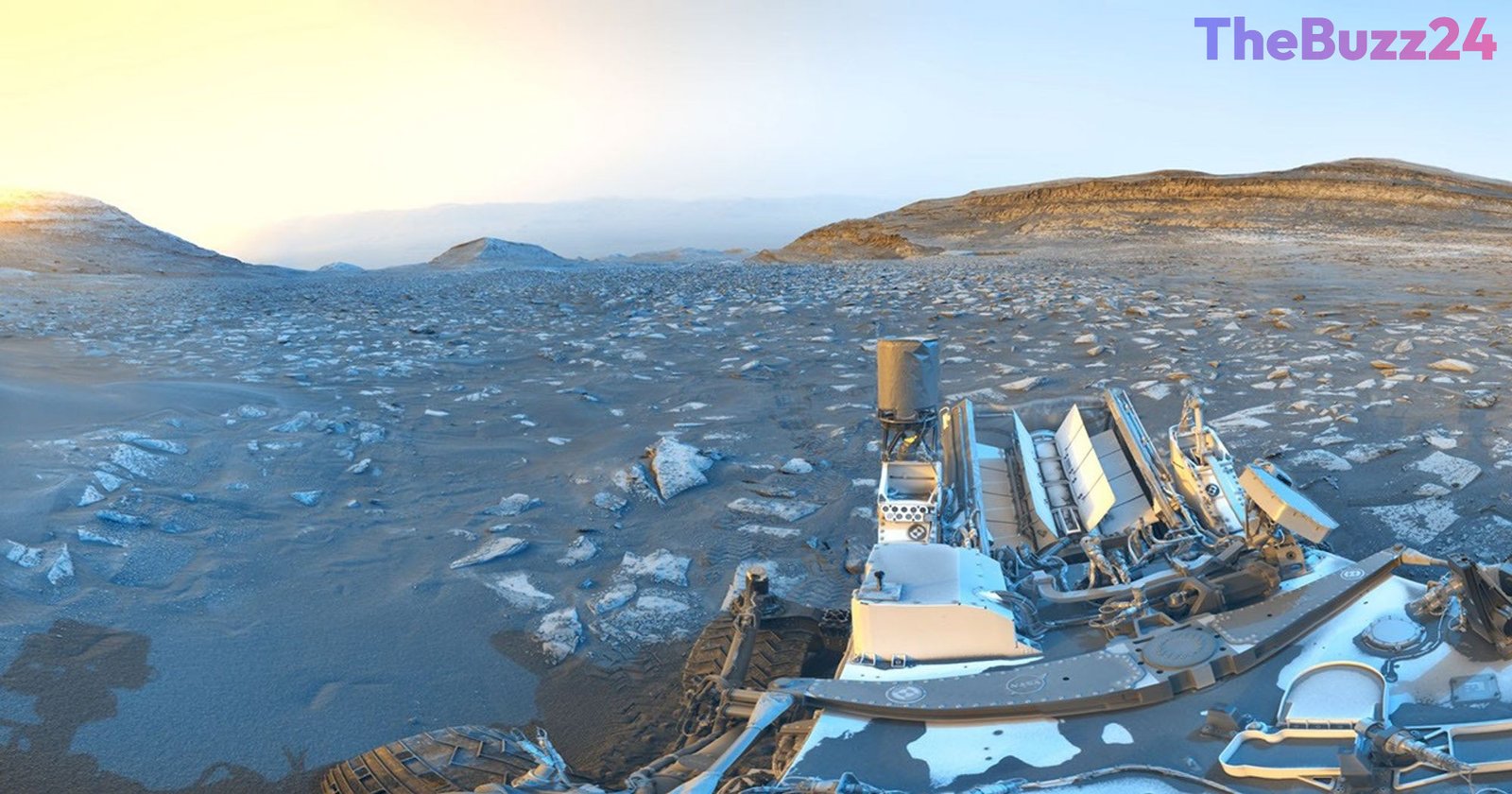
NASA’s famed Curiosity Mars rover has reached a major milestone, commemorating its 5,000th Martian day on the Red Planet. To celebrate the longevity of the historic mission, the robot explorer captured a unique dual-time panorama using its onboard navigation cameras while parked strategically at a sandy ridge known as “Chocolatal.”
The composite image, styled as a postcard, combines two distinct captures taken at different times of the Martian day. The first set of black-and-white photos was recorded during the morning hours, while the second was captured late in the afternoon. Upon transmitting the raw data back to Earth, mission specialists merged the perspectives and introduced an artistic color grading. In this creative rendition, cool blue tones signify the morning landscape, while warm yellow hues highlight the afternoon scene.
Prominently featured in the foreground of the panorama is the vehicle’s heavily instrumented deck. Key components visible include its cylindrical UHF antenna, utilized for relaying vital scientific data to orbiting spacecraft, alongside its nuclear-powered Multi-Mission Radioisotope Thermoelectric Generator situated at the rear. Faint tracks left by the rover’s wheels trail off into the surrounding terrain, emphasizing the vast distances covered during its long-term exploration.
Currently positioned along the lower foothills of Mount Sharp—a towering five-kilometer-high mountain rising from within Gale Crater—Curiosity continues to peer outward toward the crater floor and distant rim. Built and managed by the Jet Propulsion Laboratory in Pasadena, California, the ongoing mission remains a cornerstone of humanity’s sustained robotic exploration of the Martian environment.
Key Takeaways
- NASA's Curiosity rover successfully reached its 5,000th Martian day, or sol, on the Red Planet.
- The commemorative postcard combines morning and afternoon panoramas, artistically rendered with blue and yellow hues.
- The vehicle is currently stationed on the lower foothills of Mount Sharp inside Gale Crater.
Editor’s Analysis & Impact
The longevity of NASA’s Curiosity rover underscores the incredible durability and engineering excellence behind modern interplanetary exploration. Operating well beyond its initial mission parameters, Curiosity continues to provide invaluable geological data from the surface of Mars, bridging the gap between automated engineering and deep-space scientific discovery. As space agencies look toward future crewed missions, the technical insights gained from maintaining long-duration robotic assets like Curiosity remain vital. This milestone not only highlights past achievements in planetary science but also sets a high benchmark for upcoming robotic explorers slated for Mars and beyond.
Frequently Asked Questions
Q: What is a Martian sol?
A: A sol is a solar day on Mars. It is slightly longer than an Earth day, lasting approximately 24 hours, 39 minutes, and 35 seconds.
Q: How was the Curiosity postcard created?
A: The postcard was created by merging two separate black-and-white panoramas captured by the rover's navigation cameras at different times of day, with blue and yellow artistic color added to represent morning and afternoon lighting.
AI Disclosure: This article is based on verified data and official reports. Our Team and AI have cross-referenced every financial detail with primary sources to ensure total accuracy.
More from this Category