Russian Drone Strike Targets Ukrainian Security Headquarters in Kyiv
A Russian drone strike hit the headquarters of the Security Service of Ukraine (SBU) in central Kyiv on Friday, marking a significant escalation in the ongoing conflict. President Volodymyr Zelensky confirmed that the unmanned aerial vehicle was specifically aimed at the office of security chief Oleksandr Poklad. While the status of the security chief remains unconfirmed, Zelensky stated he has ordered a ‘tangible response’ to the attack, signaling a potential shift in Ukraine’s tactical approach.
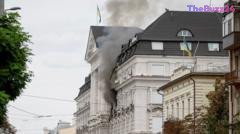
Emergency services were deployed immediately to the site, where images showed significant structural damage and smoke billowing from the building. Kyiv Mayor Vitali Klitschko reported that at least five individuals were injured during the incident, including a civilian at a nearby café that sustained collateral damage. The SBU building, located near the historic St. Sophia Cathedral, serves as a central hub for Ukraine’s defensive and intelligence operations.
This strike coincides with a broader intensification of Russian military activity, which has increasingly utilized faster, jet-powered drones that are more difficult for air defense systems to intercept. Beyond the capital, the Russian defense ministry reported additional strikes on maritime targets near Odesa and Chornomorsk. The timing of these attacks has drawn sharp criticism from Ukrainian officials, who argue that such aggression undermines ongoing international efforts to facilitate diplomatic peace talks.
Key Takeaways
- A Russian drone strike directly targeted the office of Ukraine's security chief within the SBU headquarters in Kyiv.
- At least five people were injured in the attack, which also caused collateral damage to nearby civilian infrastructure.
- The strike occurs as Russia increases the use of advanced, jet-powered drones, complicating Ukrainian air defense efforts.
Editor’s Analysis & Impact
The strike on the SBU headquarters represents a calculated escalation that challenges the security of Ukraine’s command-and-control infrastructure. By targeting a high-level intelligence facility, Russia is signaling a shift toward more precise, high-value strikes, potentially intended to disrupt Ukrainian leadership during a sensitive period of international diplomacy. The use of advanced, jet-powered drone technology suggests that the technological arms race in this conflict is accelerating, forcing Ukraine to adapt its air defense strategies rapidly. As US-led peace envoys prepare to visit the region, this incident underscores the fragility of any potential ceasefire negotiations. The broader implication is a hardening of positions, where tactical military gains are being prioritized by Moscow to gain leverage, likely leading to a cycle of retaliatory strikes that could further destabilize the region and complicate the path to a diplomatic resolution.
Frequently Asked Questions
Q: Was the Ukrainian security chief injured in the drone strike?
A: It remains unclear whether security chief Oleksandr Poklad was in the building at the time of the strike, though President Zelensky confirmed the drone was aimed directly at his office.
Q: What kind of drones is Russia currently using in these attacks?
A: Russia has increasingly employed jet-powered drones, which are faster and more difficult for Ukrainian air defense systems to intercept compared to traditional propeller-driven models.
AI Disclosure: This article is based on verified data and official reports. Our Team and AI have cross-referenced every financial detail with primary sources to ensure total accuracy.
More from this Category