Astronomers Identify Potential Supernova Remnant Near Milky Way’s Core
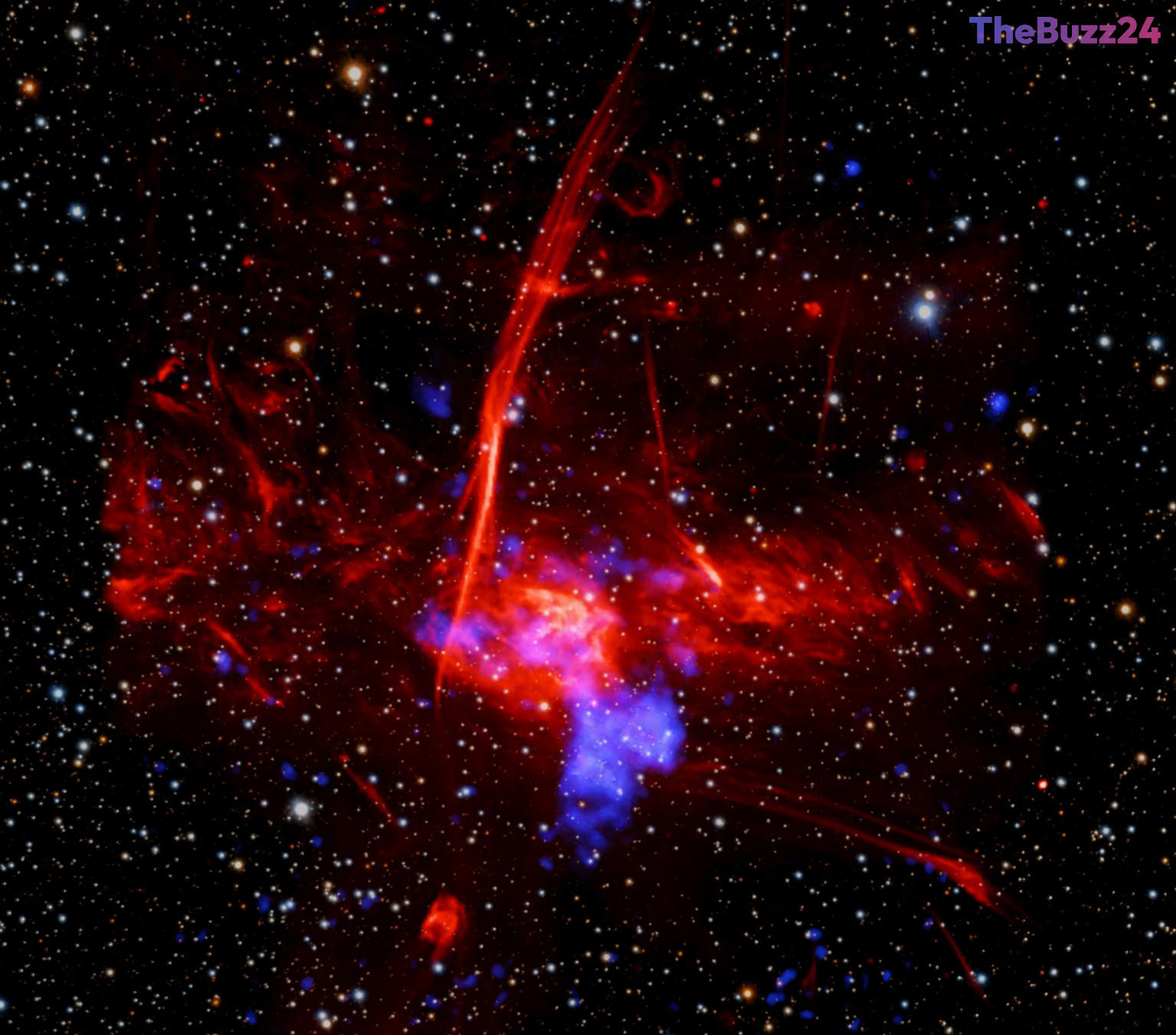
Astronomers have identified a compelling candidate for a supernova remnant located in the dense, chaotic environment of the Milky Way’s Galactic Center. By synthesizing data from multiple observatories, including the Chandra X-ray Observatory and the XMM-Newton mission, researchers have pinpointed a distinct ‘blob’ of X-ray emission that suggests the violent remains of a massive star that exploded thousands of years ago.
If confirmed, this discovery would represent one of the closest supernova remnants to the supermassive black hole at the heart of our galaxy. The suspected remnant is situated within a region known as Sagittarius C, a bubble of ionized gas surrounding a massive, young star. Preliminary calculations suggest that if the object is indeed a supernova remnant, it is approximately 1,700 years old and is expanding at a staggering velocity of two million miles per hour.
The identification process involved cross-referencing X-ray data with radio observations from the MeerKAT telescope and optical imagery from the Pan-STARRS telescopes. While the team did not detect the expected chemical enhancement typically associated with stellar debris, they suggest the material may have already dispersed and mixed with the surrounding interstellar gas. Alternative theories, such as the emission originating from a cluster of massive stars, have been largely dismissed because the observed X-ray brightness significantly exceeds that of known stellar clusters in the region.
This finding provides a rare glimpse into the life cycle of stars in one of the most extreme environments in the galaxy. Supernovae are essential to the cosmic ecosystem, as they distribute heavy elements like iron and silicon into space, providing the raw materials necessary for the formation of future stars and planetary systems.
Key Takeaways
- Researchers have identified a potential supernova remnant near the Milky Way's Galactic Center using X-ray and radio data.
- The candidate object is estimated to be 1,700 years old and is expanding at roughly two million miles per hour.
- The discovery is significant because it is located in close proximity to the galaxy's supermassive black hole, an area typically difficult to observe.
Editor’s Analysis & Impact
The discovery of a potential supernova remnant near the Galactic Center highlights the increasing efficacy of multi-wavelength astronomy. By combining X-ray, radio, and infrared data, scientists are overcoming the ‘noise’ of the dense Galactic Center to map its history. From an industry perspective, this underscores the critical importance of maintaining a diverse fleet of space-based observatories. The ability to cross-reference data from missions like Chandra, XMM-Newton, and the James Webb Space Telescope is essential for validating findings in high-interference zones. Future research in this area will likely focus on refining the chemical composition of the region to confirm the supernova origin, which would provide deeper insights into the chemical enrichment of the galaxy’s core and the evolution of massive stars in extreme gravitational environments.
Frequently Asked Questions
Q: Why is this discovery significant?
A: It is significant because it is located very close to the supermassive black hole at the center of the Milky Way, a region that is notoriously difficult to study due to its density and high levels of magnetic and gaseous activity.
Q: What is a supernova remnant?
A: A supernova remnant is the structure resulting from the explosion of a star in a supernova. These remnants are composed of ejected material expanding from the explosion site and are vital for spreading heavy elements throughout the galaxy.
AI Disclosure: This article is based on verified data and official reports. Our Team and AI have cross-referenced every financial detail with primary sources to ensure total accuracy.
More from this Category