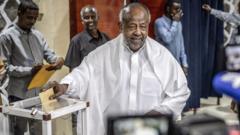
Djibouti President Secures Sixth Term Amidst Opposition Boycott
President Ismail Omar Guelleh has solidified his hold on power in Djibouti, securing a sixth term in office with a reported 97.8% of the vote. The incumbent, who has led the Horn of Africa nation for 27 years, faced minimal competition as his sole challenger, Mohamed Farah Samatar, garnered only 2.19% of the ballots cast. The election took place against a backdrop of widespread boycotts from major opposition parties, which have refused to participate in the electoral process since 2016, citing a lack of transparency and fairness.
The path to this latest victory was cleared by a significant constitutional amendment enacted last November. This change effectively removed the previous age ceiling of 75 years for presidential candidates, allowing the 78-year-old leader to seek another mandate. Throughout the campaign, the administration framed the election as a referendum on national stability, arguing that continuity is essential for maintaining order in a volatile region.
Djibouti’s political landscape remains of immense interest to the international community due to the country’s command over the Bab el-Mandeb Strait. Serving as a primary gateway to the Suez Canal, the nation hosts strategic military bases for several global powers, including the United States, China, France, Italy, and Japan. As the government prepares for the next five-year term, the focus remains on balancing domestic political consolidation with the country’s critical role in global maritime security and trade logistics.
Key Takeaways
- President Ismail Omar Guelleh won a sixth term with 97.8% of the vote following a constitutional amendment that removed age restrictions.
- Major opposition parties boycotted the election, claiming the political environment is not conducive to a fair or transparent democratic process.
- Djibouti maintains its status as a vital geopolitical hub, hosting military installations for multiple global powers due to its strategic location near the Suez Canal.
Editor’s Analysis & Impact
The re-election of President Guelleh reinforces the current political trajectory in Djibouti, ensuring that the nation remains a predictable partner for global powers. Given the country’s strategic importance as a maritime chokepoint, international stakeholders—particularly those with military assets in the region—are likely to favor the stability provided by the current administration. However, the ongoing opposition boycott suggests a fragile domestic environment. While the regime emphasizes stability, the lack of a competitive political framework could lead to long-term internal tensions. The primary challenge for the administration will be managing the eventual transition of power, as the current reliance on a single leader creates uncertainty regarding the country’s long-term governance and institutional resilience.
Frequently Asked Questions
Q: How was President Guelleh able to run for office at age 78?
A: A constitutional amendment passed in November removed the previous 75-year age limit for presidential candidates, which allowed him to qualify for the ballot.
Q: Why is Djibouti strategically significant to international powers?
A: Djibouti is located on the Bab el-Mandeb Strait, a critical maritime passage that serves as a gateway to the Suez Canal, making it a key location for global trade and military operations.
AI Disclosure: This article is based on verified data and official reports. Our Team and AI have cross-referenced every financial detail with primary sources to ensure total accuracy.
More from this Category