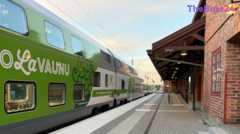
Historic Rail Link Restored: New Train Service Connects Finland and Sweden After Decades
A historic milestone in European rail travel has been reached with the launch of a new passenger train service directly linking Finland and Sweden. For the first time in nearly forty years, a rail connection has been established between northern Finland and southern Europe. The inaugural double-decker train departed from the coastal Finnish city of Oulu early Monday morning, crossing the Torne River to a warm reception of flag-waving crowds at Sweden’s Haparanda station.
The cross-border route had been suspended since the late 1980s and early 1990s, largely due to dwindling passenger numbers and technical incompatibilities. Historically, Finland’s rail network utilized wider track gauges inherited from its era as a Russian Grand Duchy, differing from the standard European track widths. However, Finland is currently upgrading its infrastructure to align with European standards. The newly revived twice-daily service takes approximately 100 minutes, traveling along Finland’s scenic west coast to Haparanda, where passengers can transfer to continue their journeys southward.
This restored connection unlocks unprecedented travel opportunities across the continent. It is now theoretically possible to embark on a 5,000-kilometer rail journey from the Algarve region in Portugal all the way to Kolari, Finland’s northernmost station, marking what is believed to be the longest continuous rail route in Europe. Additionally, the service facilitates a 24-hour overland journey between the Nordic capitals of Helsinki and Stockholm.
Transportation officials and industry leaders have welcomed the development as a symbol of deepening bilateral cooperation. Elisa Markula, chief executive of Finland’s state-owned railway operator VR, highlighted that the launch coincides with a broader “renaissance” in European rail travel, noting a significant surge in passenger demand. This new link is expected to further boost sustainable tourism and regional connectivity across northern Europe.
Key Takeaways
- A new passenger train service has successfully reconnected Finland and Sweden by rail for the first time in nearly 40 years.
- The service enables a massive 5,000km rail journey from Portugal to northern Finland, creating Europe's longest potential train route.
- The launch comes amid a broader European rail renaissance and ongoing efforts by Finland to transition its historic track widths to standard European gauges.
Editor’s Analysis & Impact
The revival of the Finland-Sweden rail link is a landmark achievement that reflects a broader structural shift in European transportation. As climate concerns drive consumers away from short-haul flights, rail travel is experiencing a major renaissance. By bridging the historical gauge gap—a legacy of Finland’s geopolitical past—this project not only enhances Nordic integration but also aligns with the European Union’s goals of creating a seamless, sustainable trans-European transport network. The economic implications are significant: increased tourism, improved regional mobility, and stronger cross-border trade. Moving forward, as Finland continues to standardize its rail infrastructure, we can expect further integration with continental Europe, positioning rail as a highly competitive alternative to regional aviation.
Frequently Asked Questions
Q: Why was the train service between Finland and Sweden suspended in the first place?
A: The route was discontinued in the late 1980s and early 1990s due to low passenger demand and technical challenges arising from different track widths between Finland and the rest of Europe.
Q: How long does the new train journey take and how often does it run?
A: The journey between Oulu in Finland and Haparanda in Sweden takes approximately 100 minutes and operates twice daily.
Q: What is the longest rail route made possible by this new connection?
A: The connection makes it possible to travel roughly 5,000 kilometers by rail from Portugal's Algarve region to Kolari, Finland's northernmost train station, which is considered the longest rail route in Europe.
AI Disclosure: This article is based on verified data and official reports. Our Team and AI have cross-referenced every financial detail with primary sources to ensure total accuracy.
More from this Category