Hubble Telescope Unveils Unusual Spiral Structure in Galaxy NGC 4698
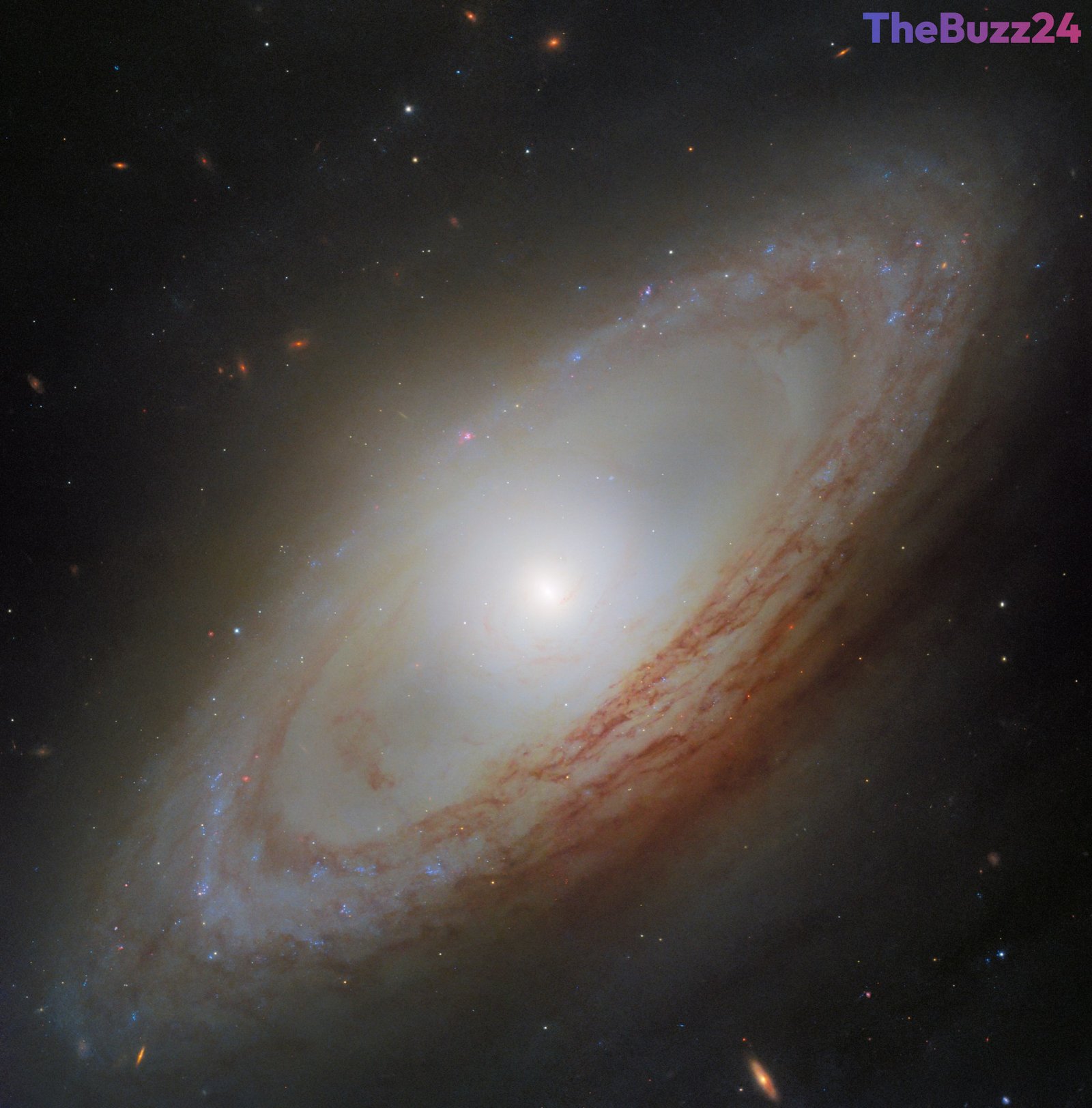
The Hubble Space Telescope has captured a striking new image of the spiral galaxy NGC 4698, revealing a complex and somewhat mysterious structural arrangement. While the galaxy appears serene at first glance, it possesses a distinct architectural anomaly that sets it apart from typical spiral galaxies like our own Milky Way. The galaxy is characterized by a thin disk composed of stars, gas, and dust, punctuated by opaque brown dust lanes and clusters of vibrant blue stars.
In most spiral galaxies, the characteristic arms wind inward toward the galactic core, creating a continuous flow of stellar material. However, NGC 4698 defies this standard pattern. Its spiral arms are primarily confined to the outer regions of the disk, appearing to avoid the galaxy’s bright, glowing center entirely. Instead of spiraling toward the nucleus, these arms form a ring-like structure that encircles the perimeter of the galaxy.
This unique configuration provides astronomers with a rare opportunity to study the dynamics of galactic evolution and the forces that shape the distribution of matter within a galaxy. By observing how these arms remain detached from the central bulge, researchers hope to gain deeper insights into the gravitational interactions and historical events that may have influenced the formation of NGC 4698, distinguishing it from its more conventional spiral counterparts.
Key Takeaways
- The spiral galaxy NGC 4698 exhibits an unusual structure where its arms do not reach the galactic center.
- The galaxy's spiral arms form a distinct ring-like pattern around its outer perimeter.
- Observations from the Hubble Space Telescope highlight the diversity in galactic morphology compared to the Milky Way.
Editor’s Analysis & Impact
The discovery of NGC 4698’s unique morphology serves as a critical reminder of the diversity inherent in galactic evolution. While standard models of spiral galaxies suggest a consistent inward winding of arms, this ‘chaotic’ or detached structure indicates that external gravitational influences or past mergers may play a larger role in galactic architecture than previously assumed. From an industry perspective, this highlights the ongoing necessity for high-resolution deep-space imaging to refine our cosmological models. As we continue to map the local universe, such anomalies act as data points that challenge existing theories on star formation and galactic stability. Future research into these ‘ring-like’ spiral structures will likely focus on the dark matter distribution and orbital dynamics that prevent these arms from migrating toward the galactic center, potentially reshaping our understanding of how galaxies mature over billions of years.
Frequently Asked Questions
Q: What makes NGC 4698 different from the Milky Way?
A: Unlike the Milky Way, where spiral arms wind toward the center, NGC 4698 features arms that remain in the outer reaches, forming a ring-like structure around the galaxy's perimeter.
Q: Why is the structure of NGC 4698 considered unusual?
A: It is unusual because the spiral arms appear to shy away from the glowing central bulge, which contradicts the typical winding pattern observed in most spiral galaxies.
AI Disclosure: This article is based on verified data and official reports. Our Team and AI have cross-referenced every financial detail with primary sources to ensure total accuracy.
More from this Category