Optimizing Aluminum Alloy 2219: Critical Manufacturing Standards for Aerospace Integrity
Aluminum alloy 2219, a staple in aerospace engineering since its development in 1954, remains a critical material for high-performance applications, including space vehicle fuel tanks and pressurized modules. Known for its exceptional cryogenic properties and weldability, the alloy’s performance is heavily dependent on the precision of its manufacturing process. Recent technical guidance highlights that improper casting and forging techniques can introduce microstructural defects, significantly increasing the material’s susceptibility to corrosion and reducing its overall structural integrity.
When casting 2219 ingots, manufacturers often encounter issues such as disparate grain sizes, macrosegregation of alloying elements, and the formation of clustered copper-rich intermetallics. These internal discontinuities are particularly problematic in large-scale castings. If these defects are present in the initial ingot, subsequent thermo-mechanical processing—such as solution treatment or aging—often fails to rectify the material’s deficiencies, leading to lower strength and poor ductility in the final product.
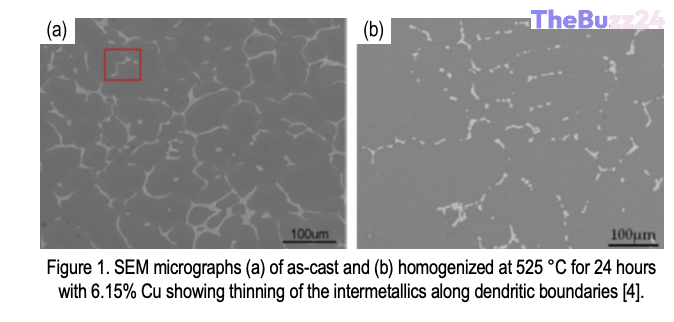
To mitigate these risks, industry experts emphasize the necessity of a rigorous homogenization step immediately following direct chill casting. By applying controlled thermal cycles, manufacturers can drive copper atoms out of interdendritic boundary zones, ensuring a more uniform distribution across the aluminum matrix. This process, when optimized for specific ingot thicknesses, dramatically reduces segregation and improves the material’s response to surface treatments.
Beyond homogenization, the implementation of multidirectional deformation, such as upset forging and rolling, is recommended to further refine the microstructure. These mechanical processes help fracture coarse particles and promote the nucleation of smaller, more uniform grains. By incorporating these steps into procurement specifications and verifying them through advanced diagnostic tools like X-ray Diffraction (XRD) or Differential Scanning Calorimetry (DSC), manufacturers can ensure that aluminum 2219 meets the stringent safety and performance requirements demanded by modern aerospace projects.
Key Takeaways
- Improper casting of aluminum alloy 2219 leads to microstructural defects that cannot be fully corrected by later processing.
- Homogenization is an essential post-casting step to ensure uniform distribution of alloying elements and improved corrosion resistance.
- Procurement specifications should mandate homogenization and multidirectional deformation to guarantee high-quality, reliable aerospace components.
Editor’s Analysis & Impact
The guidance on aluminum alloy 2219 underscores a broader trend in high-stakes manufacturing: the shift toward ‘process-as-product’ quality control. As aerospace demands grow more rigorous, the reliance on legacy materials like 2219 requires updated, data-driven manufacturing protocols to prevent catastrophic failure. The emphasis on homogenization and multidirectional deformation reflects a move toward tighter quality assurance in the supply chain. For the aerospace and defense sectors, this implies that procurement teams must move beyond simple material certification and begin auditing the specific thermal and mechanical processing steps used by suppliers. Failure to adopt these standardized homogenization practices could lead to increased maintenance costs and safety risks, ultimately driving the industry toward more automated, sensor-verified casting environments to ensure consistency across large-scale structural components.
Frequently Asked Questions
Q: Why is homogenization critical for aluminum 2219?
A: Homogenization is necessary to redistribute concentrated copper atoms and reduce segregation within the alloy, which prevents structural weaknesses and corrosion susceptibility that cannot be fixed later.
Q: What tools can be used to verify the effectiveness of the homogenization process?
A: Manufacturers can use X-ray Diffraction (XRD), Differential Scanning Calorimetry (DSC), and Scanning Electron Microscope (SEM) imaging to verify that the microstructure has been properly refined.
AI Disclosure: This article is based on verified data and official reports. Our Team and AI have cross-referenced every financial detail with primary sources to ensure total accuracy.
More from this Category